
The insurance adjuster calling you daily isn’t your friend; they’re a professional predator waiting for you to blink. They want you to believe that a split second outside a Portland crosswalk or a minor “jaywalking” error means your pedestrian accident settlement is dead on arrival. That is a tactical lie designed to protect their billion dollar profits while you’re left buried under mounting medical debt and physical trauma. You’ve been targeted by a reckless driver, and now the insurance company is targeting your right to recover.
You deserve total financial restoration, not a lowball offer that barely covers your first ER visit. It’s time to stop playing defense and start demanding accountability. This guide reveals the hard truth about forcing insurance giants to pay what they actually owe in 2026. We’ll walk you through the Oregon legal timeline, explain how to beat the “comparative negligence” trap, and show you exactly how to secure the maximum recovery possible. Your fight for justice starts by knowing their playbook better than they do and refusing to settle for anything less than victory.
Key Takeaways
- Stop falling for “average” settlement traps that insurance giants use to undervalue your trauma and protect their bottom line.
- Learn how to calculate a pedestrian accident settlement that forces the driver to pay for both your mounting medical debt and your emotional pain.
- Arm yourself with the legal facts on Oregon’s 51% bar rule to defeat the “jaywalking” myth adjusters use to kill your claim.
- Protect your case value by prioritizing immediate medical documentation and refusing to give recorded statements to aggressive insurance adjusters.
- Leverage 27+ years of elite experience to shield your family from financial ruin while a relentless advocate fights for the total restoration you are owed.
Pedestrian Accident Settlements: Why ‘Average’ is a Trap
If you are searching for the average pedestrian accident settlement, you are looking at a map drawn by your enemy. Insurance companies love averages because they hide the truth. A pedestrian accident settlement is the final financial compensation paid by an at-fault party’s insurance to cover your total losses. To be clear, this is a legally binding contract that must cover all future medical needs and financial gaps created by the crash. Signing too early means you are paying for the driver’s mistake out of your own pocket for the rest of your life.
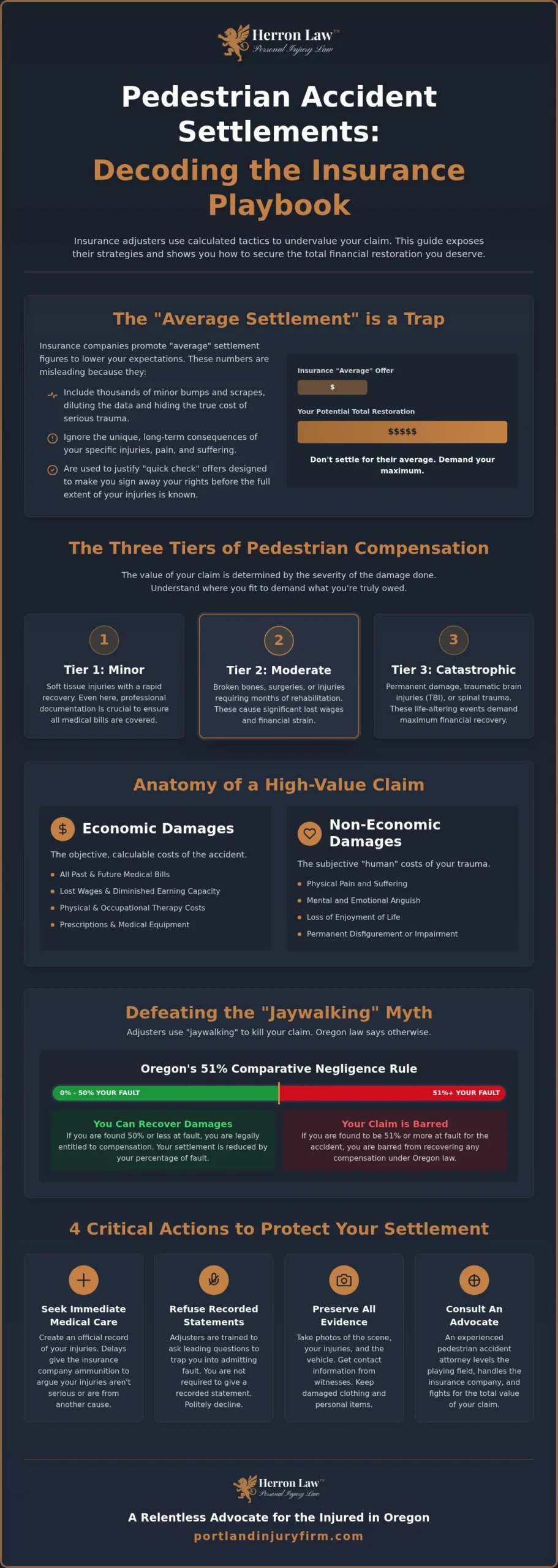
At Herron Law, we know that “average” numbers are dangerous. They include minor bumps and scrapes that dilute the data, masking the true cost of serious pedestrian trauma. Your case isn’t a data point in a corporate spreadsheet; it is a unique battle for your future. Whether you were hit in Portland, Beaverton, or Salem, we treat your claim as a high-stakes fight for total restoration. We have handled over 2,000 cases in 27 years. We don’t accept “average” because our clients don’t have “average” injuries.
The Three Tiers of Pedestrian Compensation
We categorize claims into three distinct combat zones based on the damage done to your body. Understanding where you fit is the first step in demanding what you are owed.
- Tier 1: Minor soft tissue injuries with rapid recovery. Even here, adjusters will try to pay nothing, but these cases still require professional documentation to ensure your bills are covered.
- Tier 2: Moderate injuries like broken bones or surgeries. These require months of grueling rehab and cause significant time away from work, creating a massive financial hole.
- Tier 3: Catastrophic injuries. This includes permanent damage, traumatic brain injuries, and spinal trauma. These are life-altering events that demand maximum recovery.
The value of your claim shifts dramatically based on which tier your injuries fall into. We focus on the high-stakes reality of Tier 2 and Tier 3 cases where the insurance company has the most to lose and fights the hardest to keep their money.
Why Insurance Adjusters Want You to Think in Averages
Adjusters use “industry averages” to cap your expectations before you even hire an attorney. They want you to feel lucky to receive any offer at all. This is why they often push a “quick check” offer within 48 hours of the accident. It is a trap. They want you to sign away your rights before the full extent of your trauma is documented or your doctors have finished their assessment.
They also hope you don’t understand how pedestrian safety standards and Oregon’s PIP laws work. In Oregon, you have a minimum of $15,000 in Personal Injury Protection to cover immediate medical bills. This is your shield, but adjusters often try to use these early payments to justify a lower final pedestrian accident settlement. We break their valuation models by highlighting your individual suffering and the long-term impact on your life. If you want a fighter who understands the specific practice areas of Oregon law, you need an advocate who refuses to accept a lowball “average” as an answer.
The Anatomy of a High-Value Pedestrian Claim: Calculating Your Demand
Calculating a pedestrian accident settlement isn’t about guessing. It’s about precision. We break your demand into two primary categories: economic and non-economic damages. Economic damages are the objective, line-item costs. They include every ER bill, surgery invoice, and physical therapy session. In Oregon, your own PIP coverage may pay initial bills up to the $15,000 minimum, but the settlement must reimburse the rest. This isn’t just about covering the past; it’s about securing every dollar for your future medical needs.
Non-economic damages represent the subjective “human” costs that an insurance company will try to ignore. This includes your physical pain, mental suffering, and the total loss of enjoyment of your life. Insurance adjusters typically use a “multiplier method,” multiplying your medical bills by a number between one and five, or a “per diem” rate to calculate daily suffering. We don’t let them dictate these terms. We fight to prove that your emotional trauma is worth far more than a corporate math formula.
Economic Restoration: More Than Just Hospital Bills
It starts with lost wages. We calculate your missing income from the moment of impact through your entire recovery process. We also factor in diminished earning capacity if you can’t return to your previous career. We never settle before you reach “Maximum Medical Improvement.” Why? Because demanding a dime before your doctors know your final prognosis is financial suicide. If your injuries require home modifications, like ramps or widened doorways, or long-term assistive devices, those costs must be fully funded by the at-fault party.
The ‘Invisible’ Damages: TBIs and PTSD
The latest pedestrian accident statistics reveal the staggering frequency of these collisions, but data alone can’t capture “invisible” injuries. Traumatic Brain Injuries (TBIs) frequently go undiagnosed in the chaos of an ER visit, yet they often carry the highest values in a pedestrian accident settlement. Proving psychological trauma, such as PTSD triggered by the sound of screeching tires, is a technical battle. We utilize medical experts to validate these “unseen” injuries to ensure a jury understands the depth of your struggle. You shouldn’t have to carry the burden of proof alone. If you’re struggling with the aftermath of a crash, it’s time to discuss your specific recovery options with a firm that understands the science of high-stakes litigation.
Liability & The ‘Jaywalking’ Myth: Fighting Comparative Negligence
Insurance adjusters love the word “jaywalking.” They throw it at you like a grenade, hoping you’ll drop your claim in fear. Don’t blink. In Oregon, the law is on your side more than they want you to admit. Under the doctrine of comparative negligence, you aren’t barred from recovery just because you weren’t in a painted crosswalk. You can still secure a pedestrian accident settlement as long as your share of the fault is 50% or less. The insurance giant will try to pin 51% on you to save their bottom line. We won’t let that happen. We dismantle their “pedestrian darted out” defense by exposing the driver’s own negligence. See our Practice Areas for more on how we handle complex liability battles in Portland, Beaverton, and Salem.
Unmarked Crosswalks: Your Secret Legal Shield
Every intersection in Oregon is a crosswalk. This isn’t a suggestion; it’s the law under ORS 801.220. Whether there are white lines on the pavement or not, drivers are legally required to yield to pedestrians at intersections. “Jaywalking” is a term corporate insurers misapply to intimidate victims who were legally crossing the street. We use tactical evidence to strip away their excuses. By pulling black box data from the vehicle and securing traffic camera footage, we prove driver speed and distraction. If a driver was doing 35 in a 25, their “darted out” defense evaporates instantly. We turn the law into your shield and our sword.
Overcoming ‘Partial Fault’ Allegations
The 51% Rule is the insurance company’s favorite trap. If they can push just a fraction more fault onto you, they pay zero. We fight back using accident reconstruction experts to prove the driver had the “last clear chance” to avoid you. If a driver had a clear line of sight and failed to brake, the bulk of the liability rests on them. Silence is your greatest weapon at the crash site. Never admit fault or apologize to the driver. Aggressive adjusters will call you daily, fishing for an admission that you “didn’t see” the car. Those words can slash your pedestrian accident settlement by tens of thousands of dollars. We handle the talking so you can focus on healing. Let the physical evidence and our 27 years of experience do the heavy lifting while we prepare the assault on their defense.
Tactical Steps to Protect Your Settlement Value After a Portland Crash
Survival after a collision is physical. Winning your pedestrian accident settlement is tactical. From the moment the driver hits you, the insurance company starts a clock. They’re looking for any excuse to devalue your trauma. Gaps in medical treatment are the number one way to kill your case value. If you wait three days to see a doctor, the adjuster will claim your injuries didn’t come from the crash. You need a relentless paper trail that proves every ounce of your suffering was caused by their insured driver’s negligence. Silence is your greatest asset; never give a recorded statement to an adjuster who calls you “just to check in.”
The Medical Evidence Fortress
An ER visit is just the beginning. To build a fortress around your claim, you must see specialists. A neurologist or orthopedist carries more weight with a jury than a general practitioner. Following your doctor’s orders to the letter is mandatory. If you skip a single physical therapy session, the defense will use a “failure to mitigate” argument to slash your compensation. They’ll claim you aren’t as hurt as you say because you didn’t follow the treatment plan. We recommend keeping a daily pain journal to turn abstract suffering into concrete evidence for a future jury. Document your pain using these four steps:
- Rate your pain: Use a scale of 1 to 10 every morning and evening.
- Detail limitations: Record exactly what you couldn’t do, like picking up your child or walking to the mailbox.
- Track medications: List every pill taken and any side effects like nausea or lethargy.
- Note emotional triggers: Write down instances of anxiety, flashbacks, or loss of sleep.
Dealing with Insurance Adjusters: The Shield and Sword
Insurance adjusters are trained in “friendly” tactics designed to make you lower your guard. They might sound empathetic, but they’re fishing for admissions. A common trap is the broad HIPAA release. They’ll ask you to sign a form so they can “pay your bills,” but what they’re actually doing is digging through your medical history from birth. They want to find a pre-existing condition to blame for your current pain. Don’t sign anything without a lawyer’s review. Your digital paper trail matters too; keep your social media private and never post about your recovery. The only phrase you need when an adjuster calls is “talk to my lawyer.” If you want a shield against these aggressive tactics, you should contact our team today to handle the combat for you.
Why Herron Law is the Relentless Advocate You Need in Oregon
You’ve been through enough. The road to a pedestrian accident settlement shouldn’t be another source of trauma. At Herron Law, we’ve spent over 27 years standing as a shield for victims in Portland, Beaverton, and Salem. We have handled more than 2,000 cases. We know every dirty trick the insurance giants use to stall, deny, and devalue your pain. When you hire us, you aren’t just getting a law firm; you’re getting an elite expert who has seen it all and remains unfazed by corporate opposition. We operate from a position of strength, and we are ready to fight for you.
Financial stress shouldn’t stop you from seeking justice. Our “Contingency Shield” means you pay zero dollars upfront. We take on the entire financial risk of your litigation. If we don’t win your battle, you don’t owe us a dime. This isn’t just a fee structure; it’s a commitment to your victory. We are transactionally transparent and results-oriented. You deserve total financial restoration without the fear of hourly bills or hidden costs. You are not a file number to us. You are a survivor we are sworn to protect.
The Herron Law Difference: We Don’t Settle for ‘Fair’
“Fair” is a word insurance adjusters use to describe a lowball offer that protects their profits. We don’t settle for “fair.” We pursue the absolute maximum policy limits from every available insurance tier. Our reputation for litigation precedes us in every negotiation. Insurers pay more because they know we will go to trial if they refuse to pay what you are actually owed. We have recovered millions for our clients because we refuse to back down from a fight. Learn how we handle Car Accident Lawyer cases that involve pedestrians to see our tactical approach in action.
Your Recovery Starts with a Single Call
Your recovery is our singular priority. We serve survivors across Oregon, providing free consultations for victims in Gresham, Lake Oswego, and Eugene. We handle the suffocating paperwork and the aggressive insurance combat so you can focus on healing your body. There are no upfront costs, no hourly fees, and no excuses. We deliver results. Your fight for a maximum pedestrian accident settlement starts with a single, decisive step. Contact Us Now to start your free, no-obligation tactical review. Let us be the sword and shield you need to win.
Take Control of Your Financial Restoration
You don’t have to be a victim twice. The insurance company’s “quick check” is a surrender document, not a solution. By understanding that every intersection is a legal crosswalk and documenting your trauma with precision, you’ve already shifted the power dynamic in your favor. A successful pedestrian accident settlement requires more than just filling out forms; it demands a tactical assault on the driver’s negligence and a refusal to accept anything less than total restoration for your medical debt and human suffering. You’ve survived the impact; now it’s time to survive the legal battle.
Herron Law provides the shield and sword you need to win. With 27+ years of relentless advocacy and millions recovered for injured pedestrians, we know exactly how to force insurance giants to pay what they actually owe. We handle the combat, the paperwork, and the aggressive adjusters so you can focus on healing your body. Remember, we operate on a contingency basis, meaning there is no fee unless we win your case. Demand the Justice and Compensation You Deserve-Contact Herron Law Today. Your path to victory starts with a single, decisive call. Stand up for your rights and secure the future you deserve.
Frequently Asked Questions
What is the average settlement for a pedestrian hit by a car in Oregon?
There is no single average because every injury is a unique battle. While minor claims might settle for lower amounts, catastrophic cases involving traumatic brain injuries can reach six or seven figures. Your pedestrian accident settlement depends on the severity of your trauma and the insurance policy limits available. We focus on maximizing your specific recovery rather than following a diluted industry average that protects the insurance company’s bottom line.
Can I still get a settlement if I was jaywalking or outside a crosswalk?
You can still recover compensation even if you were outside a marked crosswalk. Oregon law follows a modified comparative negligence rule. This means you are eligible for a settlement as long as you are 50% or less at fault. Additionally, ORS 801.220 defines every intersection as a crosswalk, whether it’s painted or not. Don’t let an aggressive insurance adjuster convince you that “jaywalking” destroyed your right to hold the driver accountable.
How long does it take to get a pedestrian accident settlement check?
The timeline varies based on the complexity of your injuries and the insurance company’s willingness to pay. Most cases take several months to over a year because we refuse to settle before you reach Maximum Medical Improvement. Demanding a check within weeks of the crash is a mistake. It allows the insurer to underpay you before the full cost of your future surgeries or physical therapy is even known.
What happens if the driver who hit me doesn’t have insurance?
If the driver is uninsured, we pursue a claim through your own Uninsured Motorist (UM) coverage. Oregon law requires drivers to carry at least $25,000 per person in UM coverage. This insurance is designed to protect you when a reckless, uninsured driver causes a crash. We treat your own insurance company as the adversary in these cases, ensuring they pay the full value of your pedestrian accident settlement without delay.
Should I accept the first settlement offer from the insurance company?
Never accept the first offer from an insurance company. That initial check is almost always a lowball tactic designed to make you sign away your rights before you understand the extent of your medical debt. Once you sign that release, you can never ask for another dime, even if you need surgery a month later. We use that first offer as a baseline for combat, not a final destination for your recovery.
How much does a pedestrian accident lawyer cost in Portland?
We operate on a contingency fee basis. This means there are no upfront costs and no hourly fees for you to worry about. We only get paid if we win your case and recover money for you. This structure levels the playing field, allowing you to hire elite legal representation in Portland, Beaverton, or Salem without any financial risk. Our payment is a percentage of the final recovery we seize for you.
What if the accident happened in a parking lot instead of a street?
Liability rules apply in parking lots just as they do on public streets. Drivers in parking lots are often distracted or speeding, creating a high risk for pedestrians. While these areas are private property, the driver’s duty to maintain a lookout and yield to pedestrians remains the same. We use security footage and witness statements to prove the driver’s negligence and secure the financial restoration you need to cover your medical expenses.
How does Oregon’s PIP insurance affect my final settlement?
Oregon requires a minimum of $15,000 in Personal Injury Protection (PIP) coverage. This coverage pays for your immediate medical bills regardless of who caused the accident. While PIP provides a necessary shield for early treatment, it is rarely enough to cover catastrophic trauma. Your final settlement must reimburse your PIP provider and cover all additional losses, including your pain, suffering, and future care needs that PIP does not address.