In the first half of 2026, 38 pedestrians were killed on Oregon roads, a sobering reminder that the street is a battlefield where you have the least protection. If you were a pedestrian hit by car, you aren’t just a victim; you’re a target for insurance companies looking to protect their bottom line. They’ll try to shift the blame, downplay your trauma, and leave you buried under medical expenses. It’s an aggressive tactic designed to make you settle for less than you deserve. You shouldn’t have to pay for someone else’s negligence with your health and your future.
You know that “fairness” isn’t something insurance adjusters give away; it’s something you have to seize. This article provides the roadmap to navigate the legal aftermath of your accident and secure the maximum compensation for your recovery. We will examine Oregon’s strict crosswalk laws, the critical deadlines for filing claims against negligent drivers or government entities, and the specific steps required to hold the responsible parties fully accountable. Your path to financial restoration starts with knowing your rights and refusing to back down. It’s time to turn the tables and demand the justice you’re owed.
Key Takeaways
- Secure your health and your legal case by seeking immediate medical attention and forcing a detailed police report of the driver’s failure.
- Leverage Oregon’s strict crosswalk statutes to prove driver liability, even at intersections that aren’t clearly marked or painted.
- Learn how to calculate the true value of your pedestrian hit by car claim, including future rehabilitation costs and non-economic suffering.
- Identify and dismantle aggressive insurance tactics like the “lowball” offer trap and word-twisting recorded statements.
- Partner with a battle-tested legal shield that operates on a contingency basis to ensure you never pay for justice out of pocket.
Immediate Steps After Being Hit by a Car in Oregon
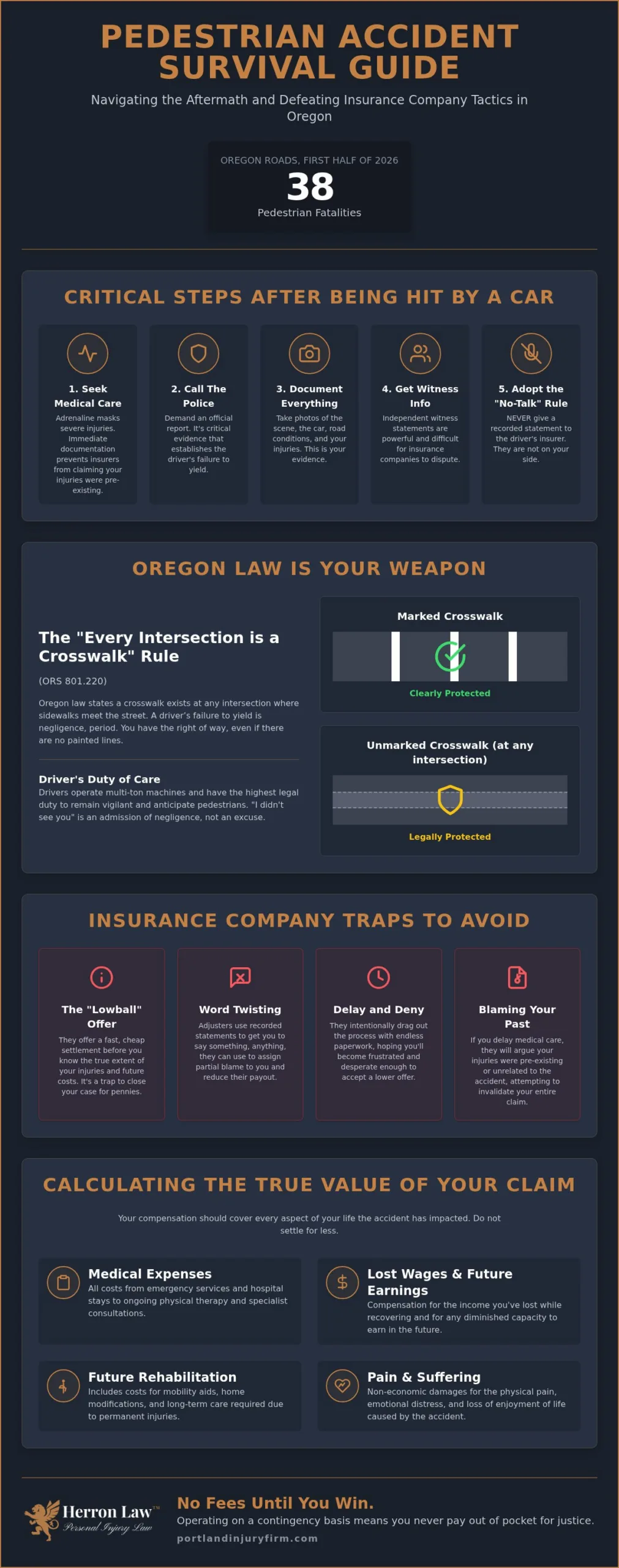
You’re on the pavement. The world is spinning. Being a pedestrian hit by car is a violent, life-altering event that leaves you vulnerable to more than just physical pain. While you’re reeling, the driver’s insurance company is already mobilizing to devalue your claim. Don’t let them. Your first move must be to seek medical attention immediately, even if you think you’re “fine.” Adrenaline is a powerful mask. Internal bleeding and traumatic brain injuries don’t always scream for attention until it’s too late. Beyond your health, pedestrian safety research shows that immediate documentation is the only way to prevent insurance adjusters from claiming your injuries were pre-existing or unrelated to the crash.
Call the police. Demand a formal report. If the officer doesn’t cite the driver, ensure the narrative clearly states they failed to yield. In Oregon, every intersection is a crosswalk; the law is on your side, but only if the facts are recorded accurately. Grab your phone. Take photos of the car’s bumper, the road conditions, and any lack of skid marks. These are your weapons. Finally, follow the “No-Talk” rule. Never speak to the driver’s insurance adjuster without a lawyer. They’ll call you within 24 hours, acting concerned. They aren’t. They’re fishing for a recorded statement they can use to manufacture fault. Hang up and let your advocate handle the fight.
Medical Documentation as Evidence
Insurance companies love a “gap in treatment.” If you wait even a few days to see a specialist, they’ll argue you weren’t actually hurt. We don’t give them that opening. Document your pain levels daily. Record how the injury limits your life. Can you walk to the kitchen? Can you pick up your child? This data builds the foundation of your Pedestrian Accident Legal Representation. Specialists play a critical role here; their testimony proves long-term disability that a general practitioner might miss.
Securing Witness Statements
Bystanders are often the most reliable source of truth because they have no “skin in the game.” Collect names and numbers immediately. In Portland neighborhoods, look for doorbell cameras or dashcam footage from cars parked nearby. On high-crash corridors like SE Powell or 82nd Avenue, third-party testimony is much harder for an insurance company to refute than your own account. If you’re too hurt to do this, contact us now so we can deploy investigators to secure this evidence before it vanishes into the night.
Oregon Pedestrian Laws: Proving Driver Liability
In Oregon, the law isn’t just a set of rules; it’s your primary weapon against the insurance companies that want to bury your claim. Drivers often assume that if you weren’t in a painted box, they aren’t at fault. They’re wrong. Under ORS 801.220, Oregon operates under the “Every Intersection is a Crosswalk” rule. This means that whether there’s white paint on the asphalt or nothing but a curb, you have the right of way the moment you step into the street at an intersection. Drivers who fail to stop can face fines up to $2,000, yet they continue to prioritize speed over NHTSA pedestrian safety tips. When you’re a pedestrian hit by car, the driver’s “Duty of Care” is the highest standard they must meet. They are operating a multi-ton machine; you are unprotected. Their failure to see you isn’t an excuse. It’s negligence.
Portland’s high-speed arterial roads, like SE Division and 82nd Avenue, are notorious battlegrounds where distracted driving and excessive speed turn intersections into trap zones. Many drivers believe they only have to yield if they see a sign or a signal. This is a dangerous myth. In reality, the burden is on the driver to remain vigilant and anticipate pedestrians at every corner. If a driver was texting, speeding, or simply “didn’t see you,” they have breached their legal duty. We don’t accept excuses. We demand accountability for the choices they made behind the wheel.
Unmarked vs. Marked Crosswalks
You don’t need a painted line to be protected by the law. Oregon law dictates that a crosswalk exists at any intersection where sidewalks meet the street at approximately right angles, regardless of whether there are painted lines on the pavement. Insurance adjusters will try to gaslight you into believing you were “jaywalking” simply because there was no paint. Don’t believe them. Your right to the road is established by the intersection itself, not by a maintenance crew’s striping schedule. If you were struck at a corner, you were likely in a legal crosswalk.
Comparative Negligence and Your Recovery
Oregon uses a “modified comparative negligence” rule, often called the 51% rule. This means you can still recover damages even if you were partially at fault, as long as your liability is not greater than the driver’s. Expect the insurance company to fight dirty. They’ll claim you stepped out too fast or wore dark clothing to push your fault over that 51% threshold and wipe out your claim entirely. We see through these tactics. Herron Law aggressively dismantles these unfair fault assignments by using crash data and witness testimony to keep the blame where it belongs: on the negligent driver. If you’re facing a “partial fault” accusation, you need to talk to a relentless advocate who knows how to win these high-stakes arguments.
Calculating the True Value of Your Pedestrian Claim
The insurance adjuster sees a claim number; we see a life upended. When you are a pedestrian hit by car, the financial impact extends far beyond the initial emergency room visit. Do not let them minimize your struggle. A full recovery requires a comprehensive calculation of both economic and non-economic damages. We don’t just ask for what you’ve lost; we demand what you will need to survive and thrive in the years to come. This includes every medical bill, every hour of lost work, and the heavy toll of psychological trauma. If the driver was acting with extreme recklessness, such as drunk driving or street racing, we also pursue punitive damages to punish the offender and maximize your recovery.
In Oregon, your Personal Injury Protection (PIP) is the first line of defense, covering a minimum of $15,000 in medical benefits. It can also cover up to 70% of your lost wages, capped at $3,000 per month for 52 weeks, provided you are unable to work for at least 14 days. However, these minimums rarely cover the fallout of a serious collision. We look past the immediate PIP benefits to the driver’s liability insurance, ensuring every cent of your long-term needs is on the table. We don’t settle for “enough to get by.” We fight for total restoration.
Maximizing Your Economic Recovery
Economic damages are the tangible, receipt-based losses you incur. But what about the income you haven’t earned yet? If your injuries prevent you from returning to your previous career, we calculate your lost earning capacity. For those facing permanent disability, we utilize “Life Care Plans.” These detailed documents, prepared by medical and financial experts, project the exact cost of future surgeries, home modifications, and daily assistance. For those suffering from life-altering trauma, our Catastrophic Injury Lawyer insights provide the tactical edge needed to prove these high-value claims.
The “Multiplier” for Pain and Suffering
How do you put a price on the inability to hold your child or the constant fear of crossing the street? Attorneys often use a “multiplier” method to quantify these non-economic damages. We take your total economic losses and multiply them by a factor based on the severity of your suffering. Your personal testimony is the heart of this claim. We document your daily pain and lifestyle limitations to show a jury the true human cost of the driver’s negligence. Expert witnesses, including psychologists and vocational experts, validate the invisible scars that insurance companies try to ignore. We make them see the person, not just the paperwork.
Insurance Tactics: They Are Not on Your Side
The insurance adjuster isn’t calling to check on your recovery. They’re calling to protect their bottom line. When you’re a pedestrian hit by car, you’re an expense they want to eliminate as quickly and cheaply as possible. They use a playbook of tactical warfare designed to make you feel powerless. From the “lowball” trap, where they offer a small check days after the crash, to calculated delay tactics, their goal is simple. They want to wear you down until you accept crumbs. They know your medical bills are piling up. They know you’re missing work. They count on your desperation to win. We don’t let them play those games with your future.
Don’t fall for the recorded statement ambush. They’ll act friendly and sympathetic, asking how you’re doing today. A simple “I’m hanging in there” or “I’m doing okay” will be twisted into legal proof that you aren’t actually injured. They are looking for any contradiction to manufacture fault. Some even play the surveillance game. They might monitor your social media or hire private investigators to catch you doing anything that contradicts your injury claims. If you post a photo at a family dinner, they’ll argue you’ve made a full recovery. It’s predatory behavior. It requires a fierce defense to overcome.
Fighting the “Victim-Blaming” Narrative
Adjusters love to blame the victim. They’ll point to your “dark clothing” or claim you were “distracted” by a phone. They’ll use the “darting” defense, arguing you appeared out of nowhere and gave the driver no time to react. These are just distractions from the driver’s duty of care. We use crash reconstruction and digital evidence to dismantle these lies. As your Personal Injury Lawyer, we act as your tactical shield, turning the focus back where it belongs: on the driver’s negligence.
Why a Settlement Offer is Rarely the End
Never sign a release before your medical treatment is finished. Once you sign that paper, you waive your right to pursue further compensation, even if you need surgery six months later. We demand the full policy limits from the driver’s insurance company. If that isn’t enough, or if the driver is uninsured, we pivot to your own underinsured motorist coverage. We leave no stone unturned. You deserve an advocate who knows how to break their “best and final” offers. If you’re being pressured to settle for less than you deserve, contact us now to protect your rights.
Herron Law: Your Tactical Shield in Portland
The aftermath of being a pedestrian hit by car is a high-stakes battle for your future. You don’t need a passive advisor; you need a relentless advocate who treats your recovery as a personal mission. Herron Law operates as your tactical shield and sword against the insurance giants that want to see you fail. Led by Bart Herron, our firm brings over 27 years of aggressive experience to the table. We’ve handled more than 2,000 cases, recovering millions for victims who were told they didn’t have a chance. We don’t just process paperwork. We prepare every case for the intensity of courtroom combat, ensuring the opposition knows we are ready to go the distance.
Our approach is built on “Total Focus.” We understand the debilitating pain and trauma you’re enduring. That empathy is why we fight so hard. Unlike massive, corporate firms where you’re just another file on a desk, we treat you as a singular priority. Our process begins with a deep-dive investigation, gathering the evidence the insurance companies hope stays buried. We work on a contingency-fee basis. This means you pay nothing upfront. Our victory is tied directly to yours; we don’t get paid unless we win your case. It’s a transparent, results-oriented partnership designed for maximum financial restoration.
Local Expertise in Oregon Cities
Success in a personal injury claim requires more than just knowing the law; it requires knowing the local landscape. We serve Portland, Beaverton, Salem, and the surrounding regions with a deep understanding of the specific court systems and insurance adjusters active in these areas. We know which tactics they favor and how to dismantle them before they take root. When you choose Herron Law, you gain direct access to Bart Herron and an elite legal team that understands the high-crash corridors of East Portland and the complexities of Pedestrian Accident Legal Representation across Oregon.
Demanding Justice Now
The clock is ticking on your right to recovery. In Oregon, the statute of limitations for a pedestrian hit by car is typically two years, but certain claims against government bodies require a formal notice within just 180 days. Evidence vanishes. Road conditions change. Memories fade. Waiting even a few weeks can jeopardize your ability to hold the negligent driver accountable. You need to act with the same urgency as the insurance companies that are already working against you. Start your path to justice today with a partner who never backs down. Contact Herron Law for a Free Consultation and let us take the fight to them.
Take Back Control of Your Future Today
You didn’t choose to be a pedestrian hit by car, but you must choose how you respond. The path to full financial restoration is often blocked by aggressive insurance adjusters who want you to settle for pennies. You now know that Oregon’s crosswalk laws provide a powerful shield and that your true recovery must include future medical needs and the human cost of your trauma. Don’t let a driver’s negligence or a corporate giant’s delay tactics determine your quality of life. You have the right to demand total accountability and a future free from the burden of someone else’s mistake.
Herron Law is built for this fight. With 27+ years of relentless advocacy and over 2,000 cases handled successfully, we have the tactical experience to win. We offer a contingency fee promise; you pay nothing unless we recover money for you. There is no risk in seeking the truth, but there is a massive risk in waiting until your legal deadlines pass. Your path to justice is just one conversation away. We are ready to serve as your shield and sword in the courtroom and beyond.
Demand the Justice You Deserve-Contact Us Now. Your recovery is our mission, and we are ready to stand with you until the battle is won.
Frequently Asked Questions
How much is a pedestrian hit by car settlement worth in Oregon?
When you are a pedestrian hit by car, settlement values depend on your specific losses, including medical bills and lost earning capacity. Every case is unique. A minor fracture might settle for one amount, while a traumatic brain injury demands millions. Oregon law requires at least $15,000 in PIP coverage, but that is just the floor. We look at the driver’s liability limits and your own underinsured motorist policy to seize every dollar available.
What happens if I was hit by a car while jaywalking?
You can still win even if you weren’t in a marked crosswalk. Oregon’s modified comparative negligence law allows you to recover damages as long as you are not more than 50% at fault. Insurance adjusters use “jaywalking” as a weapon to scare you away. We fight back by citing ORS 801.220, which recognizes unmarked crosswalks at almost every intersection. Your recovery should not be destroyed by a lack of white paint on the road.
How long do I have to file a lawsuit after being hit by a car?
The standard deadline is two years from the date you were a pedestrian hit by car. However, this window can shrink rapidly. If a government vehicle like a TriMet bus was involved, you must file a Tort Claim Notice within 180 days. Missing these deadlines means your right to justice is gone forever. We recommend starting your investigation immediately to preserve evidence and secure witness testimony while it is still fresh.
Can I still recover damages if the driver was not ticketed by police?
Yes, a police officer’s decision not to issue a ticket does not stop your civil claim. Criminal court requires proof beyond a reasonable doubt, but civil cases only require a preponderance of evidence. We conduct our own investigations to prove the driver’s negligence. We look for distracted driving, speed, and failure to yield. An officer’s oversight at a busy Portland crash scene is not the final word on your right to compensation.
Will my own car insurance cover me if I was hit as a pedestrian?
Your own auto policy is often your first source of recovery through Personal Injury Protection (PIP). In Oregon, your PIP follows you even when you are walking. It provides a minimum of $15,000 for medical expenses and helps cover lost wages if you can’t work for at least 14 days. If the driver who hit you has no insurance, your Uninsured Motorist coverage kicks in. We make sure your own insurer treats you fairly.
What if the driver who hit me fled the scene (Hit and Run)?
A hit and run is a cowardly act, but it does not end your path to recovery. You can file a claim under your own Uninsured Motorist coverage to pay for your injuries and trauma. We work with local Portland authorities and private investigators to track down video footage and witnesses. You shouldn’t be punished because a criminal fled the scene. We pursue every available avenue to ensure you are not left paying the bill.
How much does it cost to hire a pedestrian accident lawyer?
Hiring Herron Law costs you zero dollars out of pocket. We work on a contingency fee basis, which means our fee is a percentage of the money we recover for you. If we don’t win, you don’t owe us a cent for our time. This allows you to go toe-to-toe with massive insurance companies without any financial risk. We invest our own resources into your fight because we believe in winning for our clients.
What if I was hit by a city bus or government vehicle in Portland?
Claims against government entities in Portland require immediate and specific legal action. You must serve a formal Tort Claim Notice within 180 days of the accident to preserve your right to sue. These cases involve complex sovereign immunity rules and shorter windows for recovery. Whether it was a city maintenance truck or a public bus, we have the experience to navigate these hurdles. Don’t wait; the government won’t give you a second chance.