The corporate insurance adjuster calling you wants you to believe your claim comes down to the crushed metal left of your car. They are lying. In commercial litigation, vehicle damage barely scratches the surface of what determines your true truck accident settlement amount.
You are watching hospital bills pile up, feeling the strain of lost income, and facing relentless pressure from a motor carrier eager to force a predatory, lowball check into your hands. It feels like an unfair fight against a corporate empire designed to protect its own profits at your expense.
You don’t have to settle for pennies on the dollar. Discover how multi-layered commercial insurance limits, mandatory federal regulations, and catastrophic life-care damages build the real value of your claim. Below, we break down the exact legal framework used to expose corporate negligence and demand maximum financial recovery in 2026.
Key Takeaways
- Commercial semi-truck collisions involve high-stakes federal regulations and massive commercial liability policies that far exceed standard passenger vehicle limits.
- Calculating your true truck accident settlement amount requires projecting lifelong medical care, forensic vocational losses, and full non-economic damages.
- Uncovering multiple liable corporate entities, from third-party logistics brokers to negligent cargo loaders, dramatically expands your available recovery pool.
- Motor carriers can legally overwrite electronic logging telemetry and black box crash data after six months, making immediate formal preservation notices critical.
- Securing maximum financial justice requires an unyielding tactical offense to stop predatory insurance adjusters from devaluing your catastrophic claim.
Decoding Commercial Truck Settlement Amounts: Why These Claims Yield Higher Value
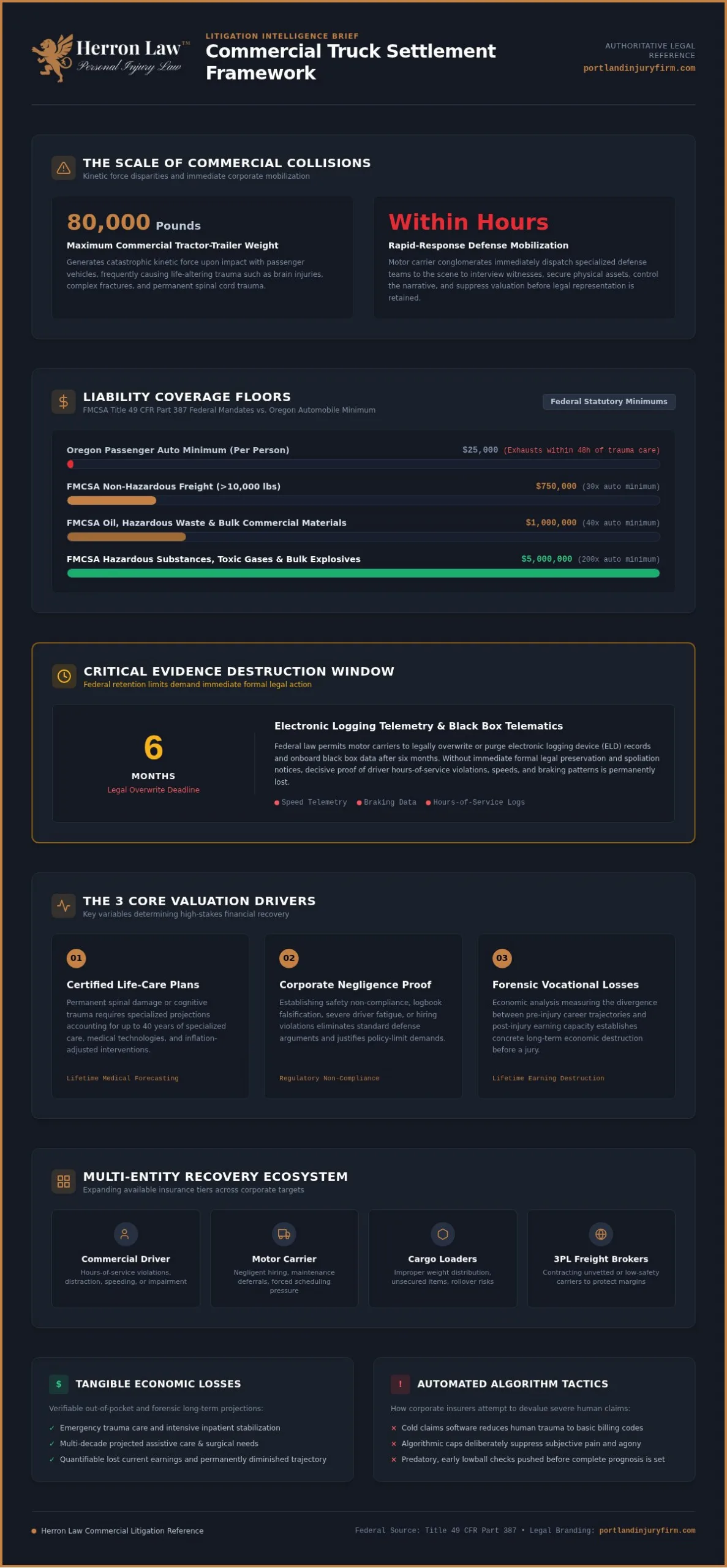
An 80,000-pound commercial tractor-trailer generates catastrophic kinetic force when it strikes a passenger vehicle. The physics alone explain why these collisions cause devastating bodily trauma, including traumatic brain damage, multiple fractures, and permanent spinal injuries. Because the resulting physical harm is so profound, a realistic truck accident settlement amount must account for past emergency interventions, lifelong specialized medical treatment, and permanently stripped earning capacity.
Corporate motor carriers know their exposure. Within hours of a catastrophic collision, trucking conglomerates deploy aggressive rapid-response defense teams to the scene. Their singular mission is to gather evidence, interview witnesses, control the narrative, and suppress claim valuation before you even contact a lawyer. Securing fair recovery means recognizing that you are fighting an institutional powerhouse built to devalue your loss.
Federal Commercial Policy Limits vs. Standard Automobile Coverage
Standard passenger car accidents are severely limited by state insurance minimums. In Oregon, for example, everyday drivers are only required to carry a meager $25,000 in bodily injury liability coverage per person. That sum disappears in the first forty-eight hours of trauma care. Commercial interstate trucking operates under an entirely different legal baseline. Under Title 49, Part 387 of the Code of Federal Regulations, the Federal Motor Carrier Safety Administration (FMCSA) mandates substantially higher financial responsibility floors:
- $750,000: Minimum public liability coverage for for-hire commercial motor vehicles over 10,000 pounds transporting non-hazardous freight.
- $1,000,000: Mandatory minimum for private and for-hire carriers hauling oil, hazardous waste, or bulk commercial materials.
- $5,000,000: Required liability limit for carriers transporting hazardous substances, toxic gases, or bulk explosives.
These multi-million dollar regulatory floors provide the deep financial reservoir required to fund intensive medical rehabilitation, complex surgeries, and round-the-clock attendant care.
The Core Variables That Drive Case Value
Insurance adjusters don’t write multi-million-dollar checks out of goodwill. Maximizing your payout requires proving the full scope of both economic and non-economic damages caused by corporate misconduct. Three primary variables dictate where your claim settles:
- Injury Severity and Care Plans: Permanent spinal damage or cognitive trauma demands formal life-care plans that project inflation-adjusted treatment costs over your lifetime.
- Undeniable Corporate Liability: Proving blatant safety violations, such as falsified logbooks or severe driver fatigue, destroys the insurer’s defense and justifies maximum policy-limit demands.
- Forensic Vocational Loss: Calculating the gap between your pre-injury career trajectory and your post-injury earning capacity demonstrates undeniable financial ruin to a jury.
Understanding these drivers allows you to reject lowball initial proposals and demand the full truck accident settlement amount your recovery requires. Explore our focused practice areas to see how our firm confronts these commercial defense machines directly.
Economic vs. Non-Economic Damages: Calculating Your Total Compensation
Insurance companies evaluate your traumatic injury through cold, automated claims software. These programs input hospital billing codes, spit out predetermined numbers, and deliberately slash the real value of human suffering. A fair truck accident settlement amount cannot be derived from an insurer’s biased algorithm. Arriving at actual financial justice demands separating your losses into concrete financial damages and subjective human agony.
Tangible Economic Losses: Medical Bills, Care Plans, and Lost Income
Economic damages compensate for verifiable, out-of-pocket financial harm. Calculating these losses begins with your immediate trauma care and intensive inpatient therapy, but it cannot end there. A complete financial recovery relies on expert financial forecasting:
- Certified Life Care Plans: Life-altering trauma requires dedicated medical specialists to project forty years of assistive technologies, home modifications, and surgical revisions. For severe trauma cases, reviewing the guidance of an experienced catastrophic injury team proves essential to capturing these lifetime expenditures.
- Forensic Vocational Calculations: If disabling orthopedic or brain injuries end your career, economists calculate your pre-crash earning power against lifetime inflation to secure full wage-replacement damages.
These hard financial losses trigger federal mandates requiring motor carriers to maintain high minimum levels of financial responsibility, giving us the legal leverage to pursue extensive corporate insurance policies.
Subjective Non-Economic Losses: Pain, Suffering, and Lost Enjoyment
Physical bills only tell half the story. Non-economic damages compensate for the destruction of your personal daily life. This encompasses chronic, relentless physical pain, post-traumatic stress, and the psychological trauma of permanent impairment. Spouses are also entitled to loss of consortium compensation for the destruction of spousal companionship, affection, and marital intimacy. To substantiate these subjective losses against combative corporate insurers, we bring in family members, treating physicians, and mental health professionals to prove the crash’s devastating human cost.
Gross Negligence and the Standard for Punitive Damages in Oregon
When motor carriers act with reckless corporate malice, standard compensation is insufficient. In Oregon, plaintiffs can pursue punitive damages by presenting clear and convincing evidence that the trucking outfit acted with deliberate disregard for public safety. Forcing drivers to violate federal hours-of-service mandates, falsifying electronic logs, or dispatching rigs with condemned brake systems triggers this severe exposure. These claims shift the leverage entirely, forcing corporate entities to pay substantially more to avoid public trial humiliation.
If you are battling predatory adjusters who treat your catastrophic injuries like an ordinary fender bender, you can request a case evaluation to start demanding the full truck accident settlement amount you deserve.
Uncovering Every Liable Party: Accessing Multiple Commercial Insurance Policies
Corporate trucking companies deploy complex shell structures to shield their profits. When a disaster strikes, their primary defense playbook is simple: point the finger at an “independent contractor” and claim zero direct liability. Falling for this shell game destroys your financial leverage. In truth, a single catastrophic semi-truck collision frequently involves four or five distinct corporate legal entities, each holding mandatory commercial coverage.
Uncovering these hidden corporate layers transforms an average claim into a substantial truck accident settlement amount. Stacking primary auto coverage, excess umbrella towers, and third-party logistics policies creates the deep capital pool required for true financial restoration.
Motor Carrier Negligence and Respondeat Superior Liability
Under the common-law doctrine of respondeat superior, motor carriers bear direct vicarious liability for the careless actions of their drivers. A company cannot escape responsibility simply by issuing an IRS Form 1099. We pursue direct corporate negligence against the carrier for systemic operational failures:
- Negligent Hiring and Retention: Employing drivers with active license suspensions, violent driving records, or documented medical disqualifications.
- Inadequate Training and Supervision: Pushing inexperienced operators into complex mountain passes or adverse weather without mandatory safety instruction.
- Mandatory Testing Violations: Skipping pre-employment drug screens or ignoring post-incident FMCSA substance testing protocols.
Holding fleet leadership accountable for cutting safety corners requires an aggressive, tactical approach from our dedicated truck accident legal representation team.
Third-Party Liability: Cargo Loaders, Maintenance Contractors, and Brokers
Liability rarely stops with the trucking carrier. Expanding your recovery requires pursuing third-party corporate entities across the freight supply chain. These corporate entities must comply with state and federal oversight, including state-level mandates enforced through the Oregon Department of Transportation commercial insurance requirements.
We target these distinct upstream entities to unlock additional policy limits:
- Third-Party Shippers and Cargo Loaders: Improperly secured freight or uneven weight distribution causes sudden jackknife crashes and catastrophic rollovers under 49 CFR Part 393.
- Outsourced Maintenance Facilities: Independent mechanics who sign off on worn brake linings, dry-rotted steer tires, or defective lighting share immediate civil liability.
- Third-Party Freight Brokers: Logistics brokers who contract cheap, dangerous “chameleon” carriers with terrible safety scores face negligent selection claims under federal safety exceptions.
By forcing each corporate insurer to tender coverage, we build the leverage needed to demand the maximum truck accident settlement amount available under the law.
Tactical Steps to Protect and Maximize Your Claim Value in Oregon
The clock starts ticking against you the second a crash occurs. What you do in the days following a wreck directly dictates your ultimate truck accident settlement amount. While you fight to heal in a hospital bed, the trucking company’s defense lawyers are already working to protect corporate assets and eliminate their liability.
Preserving Electronic Logging Devices and Black Box Telemetry
Commercial tractor-trailers contain digital flight recorders. The Engine Control Module (ECM) and vehicle telematics record critical collision data: pre-impact speed, braking engagement, steering inputs, and throttle position. Federal regulations also require Electronic Logging Devices (ELD) to track hours-of-service compliance.
Under federal regulations, motor carriers are legally required to retain ELD logs for only six months. Even worse, black box systems frequently overwrite incident registers within thirty days during regular commercial use. We stop this spoliation by firing off an immediate, formal evidence preservation demand. This legal notice freezes the data, preventing the motor carrier from quietly deleting proof of driver fatigue, speeding, or mechanical neglect.
Navigating Oregon Modified Comparative Negligence Rules
Corporate defense teams know Oregon law inside and out. Under ORS 31.600, Oregon enforces a modified comparative fault rule with a strict 51 percent bar. You can collect damages only if your share of fault is 50 percent or less. If an insurer manipulates the narrative to assign you 51 percent or more of the blame, you walk away with zero.
Any assigned fault directly reduces your final compensation. If a jury determines you bear 20 percent of the blame, your payout drops by exactly 20 percent. Insurers exploit this standard ruthlessly. They routinely manufacture allegations of sudden braking or unsafe lane changes to devalue valid claims.
Defeating Deceptive Insurance Settlement Traps and Early Lowball Offers
Insurance adjusters often arrive quickly with polite phone calls and fast settlement checks. Do not fall for this trap. These predatory offers arrive before the full extent of spinal disc damage or traumatic brain trauma is even diagnosed. Signing their broad liability release forfeits your right to demand future medical coverage forever.
Never give a recorded statement. Never sign a blanket medical authorization allowing an adjuster to weaponize your past medical history against you. Protect your rights immediately. Take decisive action and contact Herron Law today to lock down vital crash evidence and demand the maximum truck accident settlement amount you deserve.
Demanding Total Accountability: How Herron Law Fights for Maximum Recovery
Taking on a multi-billion-dollar motor carrier requires an aggressive courtroom posture. Herron Law serves as your tactical shield and sharp sword against predatory commercial insurers. With over 27 years of relentless personal injury litigation experience and more than 2,000 cases handled, lead trial attorney Bart Herron knows how commercial carriers manipulate claims. Securing your rightful truck accident settlement amount demands dismantling their corporate defenses point by point.
From Portland and the busy I-5 freight corridor across the Pacific Northwest, our firm prosecutes trucking negligence with total focus. We don’t wait for the defense to offer a fair resolution. We build undeniable trial leverage by deploying accident reconstructionists, highway safety engineers, and medical economists to quantify every dimension of your loss.
Aggressive Independent Investigation and Regulatory Enforcement
The defense begins building its case the moment a collision occurs. We hit back immediately with an intensive independent investigation. We conduct detailed physical inspections of the truck, trailer, and crash scene before vital physical evidence disappears. We subpoena maintenance logs, inspection reports, driver cell phone records, and internal dispatch communications to expose dangerous corporate cutting of corners. Explore our wide range of dedicated practice areas to see how our firm confronts complex commercial wrongdoing.
The Contingency Fee Shield: Equalizing the Playing Field
Corporate defense legal teams rely on deep pockets to drag out cases and force desperate victims into cheap settlements. We eliminate that financial advantage entirely through our contingency fee model:
- Zero Upfront Retainers: You pay nothing out of pocket to hire our seasoned trial team.
- Advanced Litigation Costs: We fund all reconstruction experts, medical specialist reviews, and deposition court reporters ourselves.
- Performance-Driven Recovery: You owe no attorney fees unless our firm secures a winning financial recovery for you.
This fee structure ensures that every injured individual receives top-tier legal combat power without taking on personal financial risk.
Take Decisive Action Before Vital Statutory Deadlines Expire
Under Oregon law, you face a strict two-year statute of limitations deadline to file a civil personal injury lawsuit. Waiting even a few months destroys essential proof: highway skid marks wash away, commercial ECM data gets overwritten, and key eyewitnesses become impossible to locate.
Stop letting corporate adjusters dictate your future. Take decisive action and contact our relentless legal team today to protect your rights, demand total corporate accountability, and fight for the maximum truck accident settlement amount you are owed.
Take Control of Your Recovery: Demand What You Are Owed
Commercial trucking corporations and their insurers protect their bottom line at all costs. Winning real compensation means refusing to let adjusters minimize your trauma with insulting, early offers. Your true truck accident settlement amount must reflect every tier of available commercial coverage, every liable corporate entity in the supply chain, and the full lifetime cost of your physical and emotional suffering.
You don’t have to face these corporate giants alone. With over 27 years fighting for injured victims across the Pacific Northwest and millions recovered against aggressive insurers, Herron Law stands ready to serve as your unyielding tactical shield. We work strictly on contingency, meaning you pay zero legal fees unless we successfully win your settlement or trial verdict.
The clock is running, and vital crash evidence won’t wait. Take decisive action now. Demand the justice and settlement you deserve by contacting Herron Law today. You have the right to fight back and rebuild your life.
Frequently Asked Questions
What is the average settlement amount for a semi-truck accident in Oregon?
There is no universal average truck accident settlement amount because each collision involves distinct injuries and coverage towers. Nationwide truck injury payouts often reach several hundred thousand dollars, while catastrophic trauma claims routinely settle for millions. Across Oregon jurisdictions like Multnomah, Clackamas, and Marion counties, your recovery depends on verified life-care costs, wage losses, and the corporate insurance layers we uncover.
How long does it take to settle a commercial truck accident lawsuit?
Resolving a commercial trucking lawsuit typically takes twelve to twenty-four months. Rushing a case plays directly into corporate hands, as insurers want quick releases before you reach Maximum Medical Improvement. We allow your doctors to establish the full permanent scope of your injuries while our investigators subpoena electronic logs and depose fleet safety directors. If an insurer refuses fair payment, we take the battle into Oregon circuit courts.
Will my truck accident settlement cover my future lost wages and ongoing medical care?
Yes, provided your legal team calculates future financial harm before signing a release. A comprehensive settlement incorporates expert economic forecasts and formal life care plans. These projections calculate expected future surgical procedures, in-home personal assistance, physical therapy, and lifetime diminished earning potential. We ensure your final payout covers every projected expense so you never bear the economic burden of corporate recklessness.
What happens if the truck driver claims I was partially at fault for the crash?
Commercial carriers constantly manufacture comparative fault defenses to slash payout values. Under Oregon’s modified comparative fault law (ORS 31.600), you can recover damages as long as you are 50 percent or less responsible. If you are assigned 20 percent fault, your payout is reduced by 20 percent. If the insurer assigns you 51 percent, you receive nothing. We dismantle these manufactured arguments using ECM telematics and crash scene forensic data.
Why do commercial truck accident claims pay significantly more than typical car accident cases?
Commercial claims yield higher recovery values for two reasons: immense physical destruction and substantial insurance policies. An 80,000-pound tractor-trailer inflicts catastrophic bodily trauma that requires lifelong medical care. In addition, federal regulations require motor carriers to carry between $750,000 and $5,000,000 in public liability coverage. This massive coverage pool provides the necessary funding for a high-value truck accident settlement amount that standard auto policies cannot match.
How much does it cost to hire an experienced truck accident lawyer in Portland?
Hiring our firm costs you nothing out of pocket. Herron Law represents injured victims across Portland, Beaverton, Gresham, and throughout Oregon strictly on a contingency fee basis. We provide free case evaluations and advance all expenses required to litigate against corporate carriers, including engineering and medical experts. You never receive an hourly bill or upfront charge, and we collect a fee only after winning financial compensation.
What happens if the trucking company deletes the black box data before trial?
Deleting black box records or electronic logs after receiving a formal spoliation notice exposes the motor carrier to severe court sanctions. Oregon judges can penalize corporate destruction of evidence by issuing adverse inference jury instructions, which tell jurors to presume the destroyed data proved the carrier’s negligence. In blatant cases, courts can strike the trucking company’s defense pleadings entirely, granting our clients an immediate legal victory on liability.