An accident is rarely just a “mistake.” When a party makes a conscious choice to ignore your safety, it’s a direct attack on your life. You aren’t dealing with a simple error; you’re facing the fallout of extreme recklessness. If you feel a standard settlement offer is an insult to your trauma, you’re right. You shouldn’t have to settle for a slap on the wrist for the responsible party. By partnering with a veteran
gross negligence lawyer, you can cut through the legal jargon and demand the maximum compensation your case deserves.
You have the right to hold these reckless actors publicly accountable for their “wanton disregard” for others. This guide breaks down the tactical steps to secure total financial restoration. We’ll examine how the 2026 Oregon liability laws, such as Senate Bill 1517, impact your claim and how to successfully pursue punitive damages. It’s time to move past the confusion and start fighting from a position of power. We’re providing the roadmap to penalize extreme negligence and win the victory your future depends on. Let’s turn your pain into a demand for justice that cannot be ignored.
Key Takeaways
- Stop settling for excuses. Learn how proving “conscious indifference” transforms a standard injury claim into a demand for total accountability.
- Uncover the technical evidence, from crash reconstruction to vehicle data logs, that forces reckless parties to face the consequences.
- Master the distinction between simple mistakes and the legal thresholds that allow a gross negligence lawyer to fight for punitive damages.
- Learn why 2026 Oregon laws mean liability waivers can’t protect those who act with reckless disregard for your life.
- Put 27 years of high-stakes litigation experience on your side with a “No Win, No Fee” model that prioritizes your recovery.
Beyond Simple Mistakes: What Defines Gross Negligence in 2026?
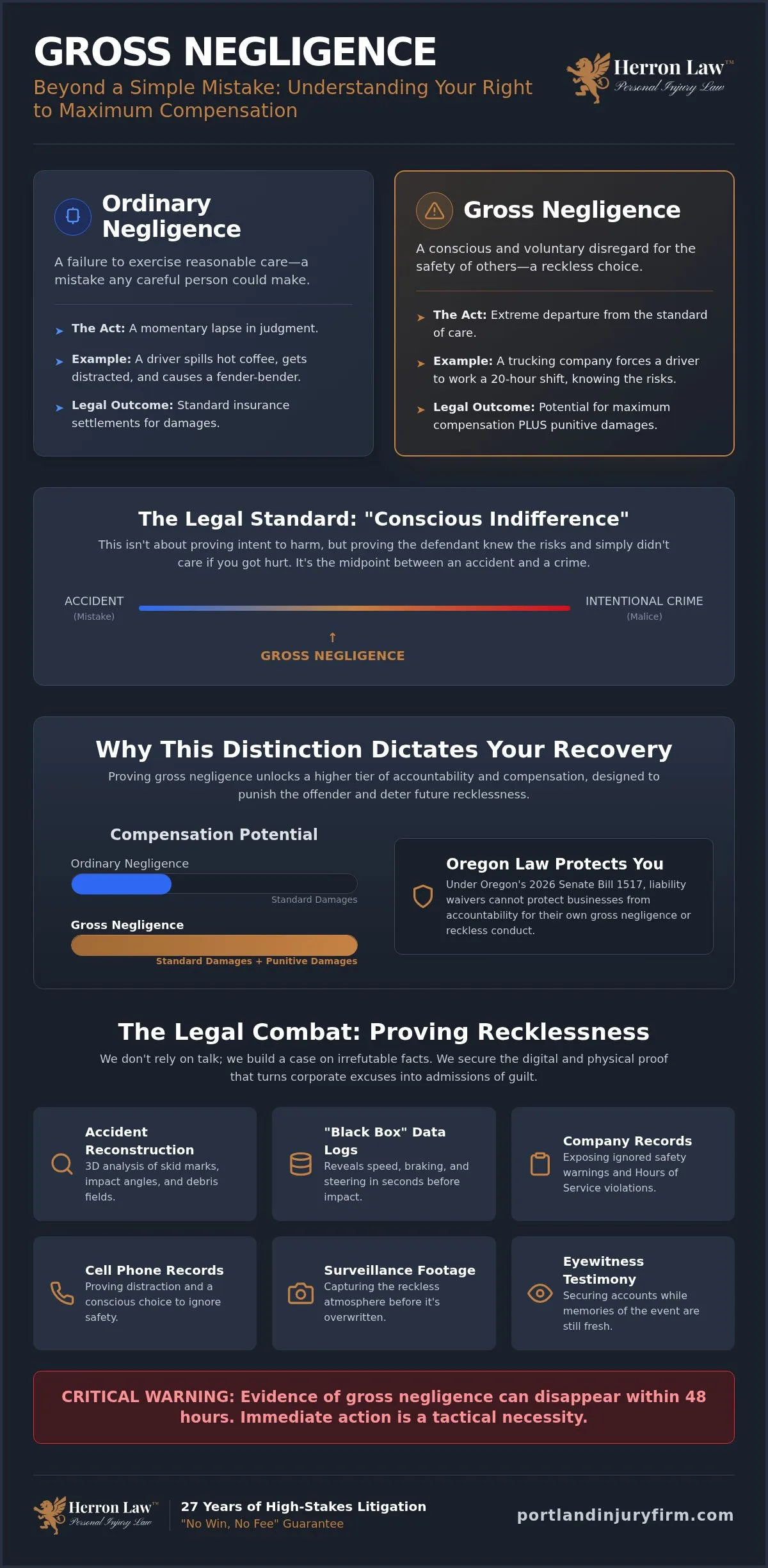
A simple accident is a mistake. Gross negligence is a calculated choice. When a driver spills coffee and causes a fender bender, that’s ordinary negligence. When a commercial trucking company forces a driver to stay behind the wheel for 20 hours straight, that’s a reckless pattern of behavior.
Gross negligence is defined as a “conscious indifference” to the safety of others. It isn’t just a momentary lapse in judgment; it’s an extreme departure from the standard of care that any reasonable person would provide. In 2026, courts are no longer guessing about intent. We use digital evidence, from vehicle telematics to smartphone activity logs, to prove that the responsible party knew the risks and chose to ignore them anyway.
The “Conscious Indifference” Standard
Legal teams often throw around the term “wanton disregard,” but for you, it means one thing: they didn’t care if you got hurt. You can think of gross negligence as the legal midpoint between an accidental slip and an intentional crime. It’s a level of recklessness so severe that it demands a higher tier of accountability. At Herron Law, we don’t just look at the crash site. We hunt for the “smoking gun” in the defendant’s conduct. This might include a history of ignored safety warnings or a deliberate decision to bypass equipment sensors. You need a
gross negligence lawyer who knows how to turn these digital footprints into a crushing blow for the defense. We expose the truth that insurance companies try to bury under layers of paperwork.
Why This Distinction Matters for Your Claim
Proving gross negligence changes the entire landscape of your recovery. It’s the key that unlocks maximum compensation. Standard insurance policies often have “soft” caps for simple mistakes, but when we prove reckless disregard, we can often push past those limits and pursue punitive damages. This distinction is also your primary weapon against liability waivers. Under Oregon’s 2026 Senate Bill 1517, businesses can no longer use waivers to escape accountability for gross negligence or reckless conduct. This is where your
Personal Injury Lawyer pillar serves as both your shield and your sword. We strip away their legal protections and ensure they pay for the full scope of your trauma. Don’t let them hide behind a “mistake” when they made a choice that changed your life forever. We demand justice that reflects the true weight of their recklessness.
The Legal Combat: Proving Reckless Disregard and Intentionality
Proving recklessness isn’t about polite conversation. It’s a high-stakes battle for facts. We deploy accident reconstruction experts who visualize the disaster in three dimensions. They analyze skid marks, impact angles, and debris fields to show exactly how the defendant failed. We don’t guess. We secure “Black Box” data from commercial vehicles. This electronic logging data reveals the cold truth about speed and braking patterns in the seconds before impact. When we combine this with toxicology reports and cell phone records, a clear picture of the
legal definition of gross negligence emerges. It exposes a driver who chose a screen or a substance over your life. This level of proof is what forces insurance giants to stop playing games and start paying what you’re owed.
Gathering the Evidence of Recklessness
Evidence is fragile. It bleeds away. In high-stakes litigation, immediate preservation is a tactical necessity. We scour Portland intersections and local businesses for surveillance footage before the loop is overwritten. We hunt for eyewitnesses while the memory of the “reckless” atmosphere is still fresh.
Evidence of gross negligence often disappears within 48 hours. If you don’t move fast, the responsible party wins by default. We act as your tactical shield, moving immediately to lock down the proof that the opposition wants to vanish. If you’ve been hurt by extreme recklessness,
starting a conversation today ensures we secure the “smoking gun” before it’s gone forever.
Corporate Negligence: When Companies Choose Profit Over Safety
The fight often goes beyond the individual driver. We look for corporate greed hidden in the logs. Many trucking companies deliberately ignore federal “Hours of Service” regulations to pad their bottom line. This isn’t just a mistake; it’s a policy of endangerment. As your
gross negligence lawyer, I hold employers vicariously liable for the destruction their drivers cause. This is
corporate combat. We prove the company knew the risks of driver fatigue and prioritized delivery times over human safety. They are responsible for the weapon they put in their driver’s hand. We make sure the penalty they pay is high enough to ensure they never take that risk again.
Ordinary vs. Gross Negligence: Why the Distinction Dictates Your Recovery
Insurance companies want to label your trauma as a “simple accident.” They want to pay the bare minimum and move on. Don’t let them. The distinction between ordinary and gross negligence dictates the size of the check you receive. By hiring a veteran
gross negligence lawyer, you ensure that the court sees the full scope of the defendant’s recklessness. Ordinary negligence is a failure to exercise reasonable care, like a driver forgetting to signal. Gross negligence is a reckless choice that ignores the safety of everyone on the road. When we prove a conscious disregard for life, we shift the conversation from mere compensation to total accountability. A jury doesn’t just want to help you; they want to stop the person who hurt you.
The psychological impact on a jury cannot be overstated. When we prove gross negligence, the jury’s focus shifts from empathy for your situation to anger at the defendant’s choices. They see a person or a corporation that thought they were above the rules. This shift is what drives high-value awards. We make the jury feel the weight of the danger the defendant created, turning their recklessness into a public liability that must be corrected. Recovery in these cases typically comes in three distinct tiers:
- Economic Damages: These cover your tangible losses, including medical bills, lost wages, and property damage.
- Non-Economic Damages: These address the intangible trauma, such as pain and suffering, emotional distress, and loss of enjoyment of life.
- Punitive Damages: This is the ultimate penalty, designed to punish the defendant for extreme recklessness and deter future misconduct.
The Threshold for Punitive Damages
In Oregon, gross negligence is the essential trigger for punitive awards. These awards are designed to punish the defendant and send a message to the public. If the conduct was egregious, the law allows us to pursue a recovery that goes far beyond your medical expenses. We use the
legal definition of gross negligence to prove that the defendant’s actions weren’t just wrong; they were dangerous. Winning these damages requires meeting the “clear and convincing evidence” standard. This is a higher bar than standard injury claims. It demands a warrior-led strategy that leaves no room for doubt. As your
gross negligence lawyer, I don’t wait for the defense to make a move. I proactively build a narrative of recklessness that forces the jury to act.
Maximizing Your Financial Restoration
Calculating your recovery isn’t a game of “insurance math.” It’s about protecting your quality of life. For those dealing with permanent changes, a
catastrophic injury lawyer is necessary to project costs over a lifetime. We factor in decades of specialized care, home modifications, and lost earning capacity. We don’t let them treat your life like a line item on a spreadsheet. We fight for every dollar of your future medical needs. We don’t just settle; we win. We ensure the responsible party pays for the choice they made, providing you with the financial fortress you need to move forward with dignity.
High-Stakes Scenarios: Gross Negligence in Oregon Traffic and Industry
Oregon’s roads and workplaces are high-stakes environments. An accident on I-5 or I-84 isn’t always just bad luck. Often, it’s the result of a conscious decision to gamble with your life. From high-speed “sideshow” racing in Portland to a logging truck operator cutting corners in the Cascades, recklessness is a choice. You need a
gross negligence lawyer who understands these local realities and knows how to dismantle the defense’s excuses. We don’t accept “it was an accident” when the evidence shows a blatant disregard for human safety. Whether it is a construction site supervisor ignoring mandatory safety harnesses or a nursing home failing to provide basic medical care, we hunt for the truth.
DUI and Excessive Speed: The Portland Reality
Driving under the influence in Portland is more than a mistake. It is a betrayal of the community. In Oregon courts, a DUI conviction is often treated as prima facie evidence of gross negligence. This means the act itself proves the recklessness. Whether it’s a drunk driver or a high-speed racer on the freeway, we pursue these cases with relentless aggression. When these choices lead to a fatal crash, we step in as your
Wrongful Death Attorney pillar to demand justice for your family. We hold street racers and “sideshow” participants accountable for the carnage they leave behind. We don’t let them hide behind the chaos of the city.
Workplace and Industrial Recklessness
Industrial zones shouldn’t be kill zones. Yet, we see supervisors intentionally disabling safety guards on heavy machinery to speed up production. This is the definition of choosing profit over people. In the Pacific Northwest logging and maritime industries, “cutting corners” can be a death sentence. We also hold nursing homes accountable when staff ignore basic hydration or medical needs. This isn’t just poor service; it’s a reckless abandonment of duty. It is a pattern of behavior that ignores the rights of the vulnerable.
If a construction site supervisor ignores mandatory safety barriers, they are responsible for every injury that follows. We identify these patterns of behavior in industrial zones across Oregon and Washington. Your recovery depends on proving that the danger was known and ignored. As your
gross negligence lawyer, I expose these corporate shortcuts. We turn the tables on companies that treat your safety as an optional expense. They assume you won’t fight back. They are wrong. If you’ve been a victim of this level of disregard, you need to act now.
Contact us today to start your fight for restoration.
Herron Law: Your Relentless Advocate for Maximum Financial Restoration
You shouldn’t have to fight billion-dollar insurance companies alone. When recklessness destroys your quality of life, you need more than a legal advisor; you need a warrior. Bart Herron brings over 27 years of experience and a history of managing 2,000+ cases to your corner. We’ve recovered millions for our clients because we refuse to accept the “insurance math” that devalues human suffering. As your
gross negligence lawyer, we operate on a “No Win, No Fee” model. This removes every financial barrier between you and high-stakes litigation. We only get paid when we win your case. This keeps our focus exactly where it belongs: on your victory and your restoration.
Settling early is often a victory for the insurance company, not for you. They want to close your file quickly before the full extent of your injuries is documented. They hope you’ll take a fast check to cover immediate bills while leaving thousands on the table. We don’t play that game. Our tactical approach involves exhaustive investigation and aggressive litigation. We prepare every case as if it’s going to trial. This proactive stance forces the opposition to take your claim seriously. We don’t just ask for fairness; we demand it through superior preparation and relentless persistence.
The Tactical Shield Against Insurance Giants
We serve as your tactical shield against “lowball” offers that ignore the gross nature of the defendant’s conduct. If they offer pennies for a life-altering trauma, we push back with the strength of a national powerhouse. Our firm is an affiliate partner of Morgan & Morgan, giving us access to massive litigation resources that most local firms simply can’t match. You get the personal attention of a focused Portland firm backed by the muscle of the country’s largest injury law firm. You are our priority. You aren’t just another case number on a spreadsheet; you are a person whose rights we are sworn to protect.
Start Your Fight for Justice Today
Time is your enemy in a legal battle. In Oregon, the statute of limitations for personal injury is generally two years, while wrongful death claims typically have a three-year window. If you wait, evidence disappears and witnesses forget. You need to act while the “smoking gun” is still reachable. We offer a free, no-obligation consultation to review the facts of your case and map out a path to recovery. We’ll tell you exactly where you stand without the confusing legalese. It’s time to stop being a victim and start being a victor.
Contact Herron Law now to demand the justice you deserve.
Seize Your Right to Maximum Recovery
Recklessness isn’t a mistake; it’s a choice that demands a heavy price. You’ve seen how proving “conscious indifference” separates a simple accident from a high-stakes legal battle. This distinction is the only way to unlock punitive damages and force real accountability for the trauma you’ve endured. Don’t let insurance giants minimize your pain with a lowball settlement that ignores the severity of their client’s conduct. You have the right to demand a recovery that reflects the true weight of your loss.
By partnering with a battle-tested
gross negligence lawyer, you put 27 years of elite experience and over 2,000 cases handled in your corner. We don’t just file paperwork. We launch a tactical assault to secure every dollar of your financial restoration. As an affiliate partner of Morgan & Morgan, we bring the resources of a national powerhouse to your local fight. We have the strength to outlast and outmaneuver any opposition.
Our “No Win, No Fee” guarantee means we only get paid when you win. The statute of limitations is ticking, and evidence is fading every hour you wait. Stop being the victim and start your recovery today.
Demand Maximum Justice: Contact Our Gross Negligence Team Now. Your future is worth the fight, and we’re ready to lead the charge.
Frequently Asked Questions
What is the difference between negligence and gross negligence?
Negligence is a simple mistake; gross negligence is a reckless choice. Negligence happens when someone is careless, like failing to use a turn signal. Gross negligence involves a “conscious indifference” to the safety of others. It’s an extreme departure from standard care. Proving this distinction is vital because it allows your
gross negligence lawyer to pursue punitive damages that go beyond standard medical bills and lost wages. This creates a path to total financial restoration.
Can I sue for punitive damages in a gross negligence case in Oregon?
Yes, you can pursue punitive damages if the defendant’s conduct was egregious. In Oregon, these awards are meant to punish the wrongdoer rather than just compensate the victim. You must meet a high “clear and convincing evidence” standard to win. Our team builds a tactical case to prove the defendant acted with wanton disregard. We ensure the penalty is severe enough to prevent future reckless behavior and maximize the value of your recovery.
How do I prove that a driver was being grossly negligent?
We prove recklessness by securing digital and physical evidence before it disappears. This includes “Black Box” data from commercial trucks, cell phone records showing distracted driving, and toxicology reports. We also deploy accident reconstruction experts to visualize the impact. By gathering surveillance footage from Portland intersections, we establish a “reckless” atmosphere. This proves the driver made a conscious choice to ignore the safety of everyone on the road, leaving no room for excuses.
Is a DUI considered gross negligence?
Drunk driving is frequently treated as prima facie evidence of gross negligence in Oregon courts. Choosing to get behind the wheel while intoxicated is a blatant disregard for human life. When a driver is under the influence, their actions move beyond a simple error into the territory of extreme recklessness. We use DUI convictions to demand maximum financial restoration and hold the responsible party fully accountable for the destruction they caused to your life.
What if I was partially at fault for the accident?
Oregon follows a comparative negligence rule. You can still recover damages as long as you are not more than 50 percent at fault. However, if the other party’s conduct reached the level of gross negligence, their responsibility is significantly higher. We fight to ensure the insurance company doesn’t use minor mistakes on your part to shield a reckless driver from the consequences of their extreme disregard for your safety. We protect your right to recovery.
How long do I have to file a gross negligence lawsuit in Portland?
The general statute of limitations for personal injury in Oregon is two years from the date of the injury. For wrongful death claims, you typically have three years. If your claim involves a government entity, you must file a formal notice within 180 days. Missing these deadlines will kill your case. You need to act immediately to preserve evidence and secure your right to fight for the maximum compensation your case deserves.
Will my gross negligence case have to go to trial?
Not necessarily, but we prepare every case as if it is headed for a courtroom. Insurance giants are more likely to offer a fair settlement when they see we are ready for combat. If they refuse to acknowledge the gross nature of the negligence, we won’t hesitate to take them to trial. Our goal is victory, whether that happens through a high-value settlement or a decisive jury verdict in your favor.
How much does a gross negligence lawyer cost?
We operate on a “No Win, No Fee” contingency basis. You don’t pay us a single dime out of pocket to start your case. We only collect a fee if we successfully recover money for you. This model removes the financial barriers to high-stakes litigation. It allows you to hire an elite
gross negligence lawyer without any upfront costs. We take the risk so you can focus on your recovery.