The first offer from an insurance company isn’t a peace offering. It’s a calculated test of your resolve. When you’re staring at a stack of medical bills and wondering how to fight insurance company settlement tactics, you must realize that adjusters aren’t your friends. They’re trained to protect their profit margins at your expense. You feel the pressure to sign a release quickly, but that signature is exactly what they want to end your claim for pennies on the dollar.
You have the right to demand more. We’ll show you the high-stakes tactics required to reject lowball offers and force insurance companies to pay the full value of your claim. This guide covers how to weaponize your medical evidence, hold insurers accountable for delay tactics, and navigate critical 2026 legal deadlines. You’ll learn how to stop being a victim of their process and start acting as the lead negotiator. It’s time to stop playing defense and start fighting for the recovery you deserve.
Key Takeaways
- Uncover why the insurance company’s first offer is a calculated trap meant to strip away your rights before you fully heal.
- Build an undeniable evidence arsenal by moving beyond basic ER records to specialist evaluations and quality-of-life documentation.
- Learn the precise tactics of how to fight insurance company settlement attempts through line-by-line rejections and ironclad demand letters.
- Spot the red flags of bad faith tactics, from unreasonable delays to policy misrepresentations, that insurers use to exhaust your resolve.
- Leverage the contingency shield to secure high-stakes legal representation without paying a single dollar in upfront costs.
Why Your Initial Settlement Offer Is a Trap
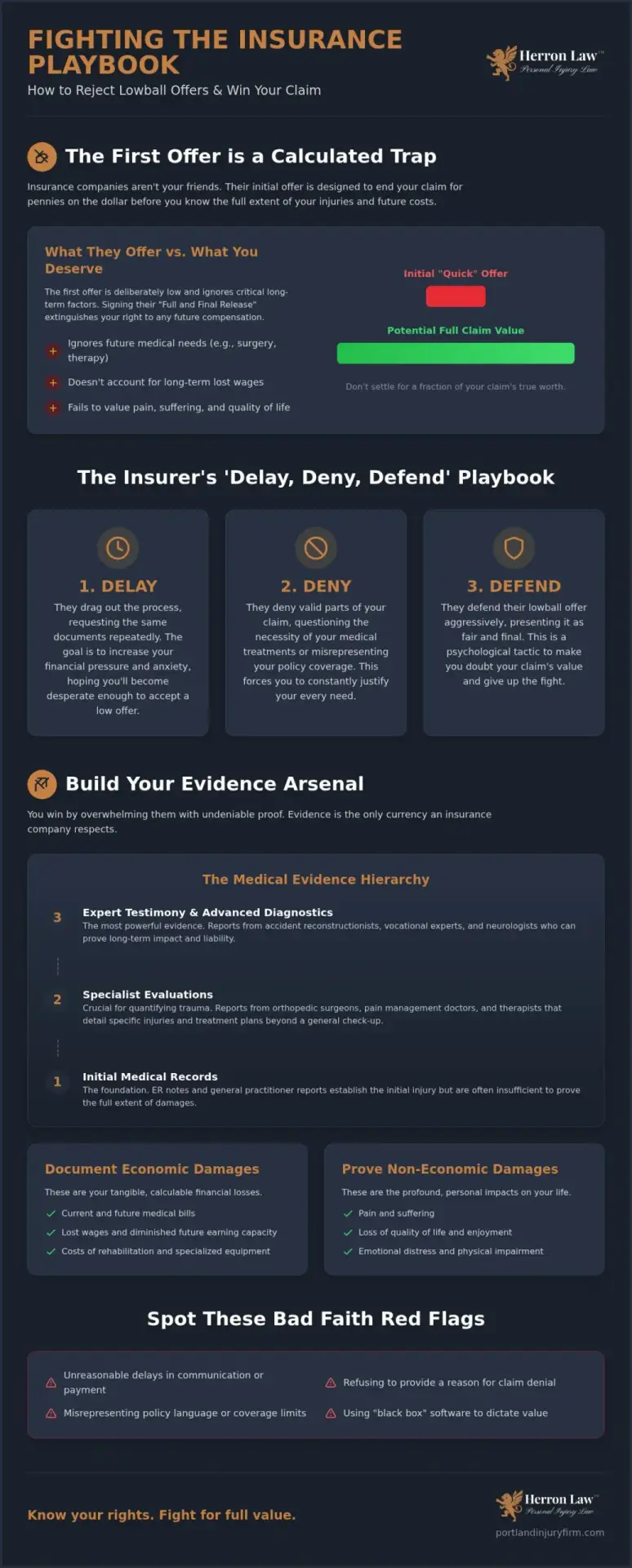
The phone rings just days after your accident. The adjuster sounds sympathetic, almost like a friend. They offer you a “fast settlement” to cover your immediate bills and a little extra for your trouble. This is the “Exploding Offer” tactic. It’s designed to make you sign a release before you even know the full extent of your injuries. Soft tissue damage, internal trauma, and traumatic brain injuries often take weeks to manifest fully. If you sign now, you’re gambling with your future health. Accepting that first check is almost always a massive financial mistake because it’s based on their needs, not yours.
When you sign that document, you’re signing a “Full and Final Release.” There are no second chances. If you discover you need a $50,000 spinal surgery six months from now, the insurance company will simply point to your signature and walk away. A foundational step in understanding insurance law is realizing that these contracts are built to protect the insurer’s bottom line, not your recovery. Once the deal is done, your right to seek further compensation is extinguished forever. They want you quiet. They want you cheap. They want you gone.
The ‘Delay, Deny, Defend’ Playbook
Insurers use a specific strategy to wear you down. They delay your claim by requesting the same documents repeatedly. They deny valid parts of your medical treatment. Finally, they defend their lowball offer as if it’s the only option you have. It’s a psychological game. They know your bills are mounting. They know you’re missing work. By dragging their feet, they hope to increase your anxiety until you become desperate enough to take any amount they offer. Knowing how to fight insurance company settlement tactics starts with recognizing that their “final” offer is just a starting point for the real battle.
How Adjusters Calculate (and Undervalue) Your Claim
Adjusters don’t look at your life; they look at a screen. Most major insurers use “black box” claims software like Colossus to determine what your injury is worth. These programs assign arbitrary point values to your pain and suffering, often ignoring the unique ways an injury has destroyed your quality of life. Claims software is a tool designed to prioritize corporate profit over human recovery. They’ll tell you your car’s “market value” is lower than it is or that your physical therapy is “non-standard.” Don’t believe them. These numbers are generated by algorithms programmed to save the company money, not to make you whole. You aren’t a data point, and your recovery shouldn’t be dictated by a line of code.
Building Your Evidence Arsenal: The Foundation of a Fight
You don’t win a high-stakes negotiation through politeness or patience. You win through overwhelming force. Evidence is the only currency the insurance company respects. If you want to know how to fight insurance company settlement tactics, you must build a case that makes a courtroom battle look like a financial disaster for the insurer. You aren’t just filing a claim; you’re preparing for a strike.
The Medical Evidence Hierarchy
General practitioners are a necessary starting point, but specialist reports are your primary weapons. You need neurologists, orthopedic surgeons, and pain management experts who can quantify your trauma in ways a standard ER note cannot. Documenting “invisible” injuries like traumatic brain injuries, PTSD, or chronic nerve damage requires advanced diagnostics and expert narratives. Be wary of the Independent Medical Examination (IME). These are not independent; they are often “hired gun” doctors paid by the insurer to find reasons to minimize your suffering and deny your benefits.
If the insurer refuses to acknowledge the depth of your medical needs or the necessity of your treatment, you may need to appeal an insurance company decision to keep the pressure on. Every medical record should be a brick in the wall of your case.
Documenting Economic and Non-Economic Impact
A fair settlement must cover your future, not just your past medical bills. We look at future lost earning capacity and the long-term cost of specialized rehabilitation that your initial bills don’t show. Non-economic damages, such as loss of quality of life or physical impairment, are proven through “Day in the Life” journals, photos of your recovery process, and witness statements from those who see your daily struggle. If you aren’t sure how to quantify these deep personal losses, consulting with a dedicated legal team can help you value your claim accurately before you speak to an adjuster.
Expert testimony from accident reconstructionists and vocational experts provides the final layer of your arsenal. Reconstructionists use physics and data to prove the other driver’s fault, while vocational experts prove how your injury will impact your ability to work for the next twenty years. When you present a wall of facts, the adjuster’s “black box” software becomes irrelevant. You aren’t just asking for money; you’re demanding a recovery based on undeniable proof and expert analysis.
The Counter-Offer Strategy: How to Reject and Demand More
You’ve gathered the evidence. You’ve seen the specialists. Now, it’s time to strike back. A lowball offer isn’t just an insult; it’s a tactical opening. To win, you must pivot from victim to aggressor. Understanding how to fight insurance company settlement tactics means knowing that your first counter-proposal sets the ceiling for the entire negotiation. Don’t just ask for more money. Demand a specific, justified sum based on the reality of your losses. If you don’t treat this like a battle, you’ve already lost.
Before you send a single word, you must establish your “floor.” This is the absolute minimum amount you’ll accept before walking away and filing a lawsuit. If you don’t have a floor, you don’t have a strategy. You’re just guessing. Once you’ve set that number, use the power of silence. After you deliver your counter-offer, stop talking. Let the adjuster sit with the pressure. The first person to speak usually loses ground. While the process for injury claims is aggressive, the right to appeal an insurance company decision remains a core principle of consumer protection that you must exercise with relentless focus.
Anatomy of a Winning Demand Letter
Your demand letter is your opening statement in the war for your recovery. Start with a cold, hard statement of liability. Don’t use “maybe” or “perhaps.” State the facts that prove their insured is 100% at fault. Follow this with a detailed damages section. Categorize every medical bill, every hour of lost wages, and every specific instance of physical pain. Attach your specialist reports as exhibits. Finally, include a time-limited demand. Give them a strict deadline, usually 14 days, to respond. Urgency forces them to move your file to the top of the pile.
Negotiation Tactics for the Underdog
Expect the adjuster to use the “Final Offer” bluff. They’ll tell you their hands are tied or that the supervisor won’t go a penny higher. It’s a lie. It’s a script designed to make you fold. Counter this by citing comparable cases where juries awarded significantly more for similar injuries. This shows them you aren’t afraid of a courtroom. Keep every single communication in writing. If they call you, follow up with an email summarizing the conversation. A paper trail is your shield against misrepresentation and your sword if the case goes to trial. You are building a record of their refusal to be fair. Use it.
Identifying Bad Faith: When the Insurance Company Breaks the Rules
The insurance company isn’t just a business; it’s a fiduciary. They have a legal obligation to handle your claim with a baseline of honesty and speed. When they cross the line into “Bad Faith,” they aren’t just being difficult. They are breaking the law. Knowing how to fight insurance company settlement tactics means recognizing when an adjuster has stopped negotiating and started acting illegally. This shift in the battle changes everything. It moves the conflict from a simple dispute over value to a high-stakes legal confrontation where the insurer’s own assets are at risk.
Bad faith occurs when an insurer puts its profits above its duty to you. Insurance Bad Faith is a breach of the implied covenant of good faith and fair dealing. This isn’t a minor technicality. It is a fundamental violation of the contract. When we identify bad faith, the “policy limits” often disappear. You may be entitled to damages that far exceed the original insurance cap, including punitive awards designed to punish the company for its predatory behavior. A negotiation that was once about medical bills can turn into a secondary lawsuit that costs the insurer millions.
For Florida residents facing such tactics, The Law Office of Raphael A. Sanchez provides the specialized legal advocacy needed to challenge bad faith denials in both personal injury and homeowner’s insurance claims.
For residents searching for a personal injury lawyer Miami, localized expertise is essential to challenge these corporate tactics and secure a fair recovery.
Red Flags of Insurance Bad Faith
Adjusters count on your silence. They hope you’ll mistake their illegal tactics for standard procedure. Watch for these warning signs. In 2025, claim delays were the top consumer complaint, accounting for 22% of all reports to insurance commissioners. If they’re dragging their feet without a valid reason, they’re likely trying to starve you out financially. Offering a settlement that is significantly lower than the evidence supports is another direct violation. An insurer cannot deny a claim without a thorough, documented investigation. If they haven’t spoken to witnesses or reviewed the police report, their denial is a sham and a clear breach of duty. This same bad faith playbook is used against victims in all types of injury claims — including those who need a dog bite lawyer to fight back against insurers minimizing severe attack injuries.
Escalating the Fight Beyond the Adjuster
If you’re being stonewalled, stop talking to the adjuster. They’ve proven they won’t be fair. It’s time to escalate. Filing a formal complaint with the state’s Department of Insurance puts the company on a government radar. However, the real leverage comes from the threat of a bad faith lawsuit. This changes the power dynamic instantly. The insurer is no longer just fighting your injury claim; they’re defending their license and their corporate reputation. We use bad faith evidence as a hammer in final settlement conferences to demand the maximum recovery possible.
If you suspect your claim is being handled with malice or intentional neglect, you need a high-performance partner to hold them accountable. Contact our team of relentless advocates to turn the tide and force the insurer to face the consequences of their actions. Don’t let them break the rules and get away with it. You have rights; it’s time to enforce them.
Why a Relentless Advocate Is Your Best Weapon in the Fight
Multi-billion dollar insurance companies don’t fear individuals. They fear consequences. When you try to handle a claim alone, you’re bringing a knife to a gunfight. They have legions of adjusters and legal teams dedicated to one goal: paying you as little as possible. Leveling the playing field requires more than just knowing how to fight insurance company settlement tactics; it requires the weight of a high-performance law firm behind you. We turn the tables by making it more expensive for them to fight you than to pay you.
Our “Contingency Shield” removes the financial fear from the equation. You get elite legal representation with zero upfront costs. We only win when you win. This model ensures our interests are perfectly aligned with yours. The real leverage, however, is the trial threat. Insurers keep databases on which firms actually go to court and which ones settle for whatever is offered. Because they know we’re willing to take them to trial, their settlement offers often increase significantly before a jury is even selected. You move from a victim of their process to a victor in your own recovery.
The Herron Law Advantage: Decades of Combat
Bart Herron has spent over 27 years acting as the sword and shield for the injured. With over 2,000 cases handled and millions of dollars recovered, we’ve seen every trick in the adjuster’s playbook. We don’t treat you like a file number. Our “Total Focus” approach means your case is a singular priority. Additionally, our partnership with Morgan & Morgan amplifies our reach. We have the resources of a national powerhouse combined with the personal, aggressive touch of a boutique litigation firm. We have the firepower to out-last and out-fight any insurance carrier in the country.
Your Next Move: The Free Strategy Session
The moment you partner with us, the harassment stops. We immediately take over all communication with the insurance company. You don’t have to answer their calls, explain your injuries to their adjusters, or worry about missing a trap in their paperwork. In your first high-stakes consultation, we’ll map out a counter-strike strategy designed for maximum recovery. This is your first step toward holding them accountable. Demand the justice you deserve—Contact Herron Law today for a free consultation.
Secure the Justice Your Recovery Demands
The insurance company has a plan to strip your claim of its value. You need a better one. Rejecting the initial trap and building a fortress of evidence are the first strikes in your counter-attack. Mastering how to fight insurance company settlement tactics is about resolve, not just paperwork. You’ve been the victim long enough. It’s time to become the victor.
Herron Law brings 27 plus years of combat experience and a record of over 2,000 cases handled to your side. We operate on a strict no win, no fee basis. We only get paid when you win. This is about your rights and your future. We’re ready to be your sword and shield against the insurance giants.
Fight back against lowball offers—Get your free case evaluation from Herron Law now.
Take the lead in your recovery today. We’re standing by to fight for you.
Frequently Asked Questions
Can I still fight an insurance company if I already accepted a check?
If you signed a “Full and Final Release” document, your case is likely closed forever. Insurance companies use these releases to extinguish your right to seek further compensation once the check is cashed. However, if you only accepted a check for property damage and haven’t signed a liability release for your injuries, you may still have a path to pursue a claim. Never sign anything without a legal review of the fine print.
What should I do if the insurance company says their offer is ‘final’?
Treat a “final” offer as a standard negotiation bluff. This is a script designed to test your resolve and force you to settle for less than you deserve. When you know how to fight insurance company settlement tactics, you respond by rejecting the offer in writing and presenting new, undeniable evidence of your losses. A “final” offer often changes once they realize you’re prepared to take the fight to court.
How long do I have to file a lawsuit if the settlement negotiations fail?
Time is a weapon the insurance company uses against you. As of May 2026, the statute of limitations varies significantly by state. For example, you have two years to file in states like California, Texas, and Florida, while you have three years in New York or Washington. If you miss this deadline, your right to recover any money is gone. We track these deadlines to ensure your right to a trial is never compromised.
Is it worth hiring a lawyer if my injuries seem minor?
Yes, because “minor” injuries often mask long-term physical and financial damage. Soft tissue injuries or concussions may not show their full impact for weeks or months. Insurers rush to settle these claims quickly because they want to pay pennies before you realize you need ongoing therapy or specialized care. We ensure your settlement covers the true, long-term cost of your recovery, not just your initial ER visit.
What happens if I reject the insurance company’s offer and go to court?
The battle moves from a claims office to a courtroom. We file a formal complaint and begin the discovery process, which forces the insurer to justify their lowball offer under oath. This process often reveals that the insurer ignored evidence or used flawed software to devalue your claim. Often, the pressure of an impending trial date is exactly what makes the insurance company finally offer a fair settlement.
Can the insurance company cancel my policy if I fight their settlement offer?
No. State laws strictly prohibit insurance companies from canceling your policy as retaliation for filing a legitimate claim or disputing a settlement offer. You have a contractual right to seek the full value of your policy. If an insurer threatens your coverage because you’re demanding fairness, they may be crossing the line into bad faith territory, which gives us even more leverage in your fight.
How much does a personal injury lawyer charge to fight an insurance company?
We operate on a contingency fee basis, which acts as your financial shield. You pay nothing upfront, and we cover all the costs of building your evidence arsenal. We only get paid when we win your case. Our fee is a percentage of the final recovery we secure for you. If we don’t recover money, you don’t owe us a dime. This ensures we’re as invested in your victory as you are.
What is a ‘bad faith’ insurance claim and how do I prove it?
Bad faith is a breach of the insurer’s legal duty to handle your claim fairly and honestly. You prove it by documenting unreasonable delays, failure to conduct a thorough investigation, or intentional misrepresentation of your policy terms. In 2025, claim handling delays were the top complaint to state commissioners. When we prove bad faith, we can often pursue damages that exceed your policy limits to punish the insurer’s misconduct.