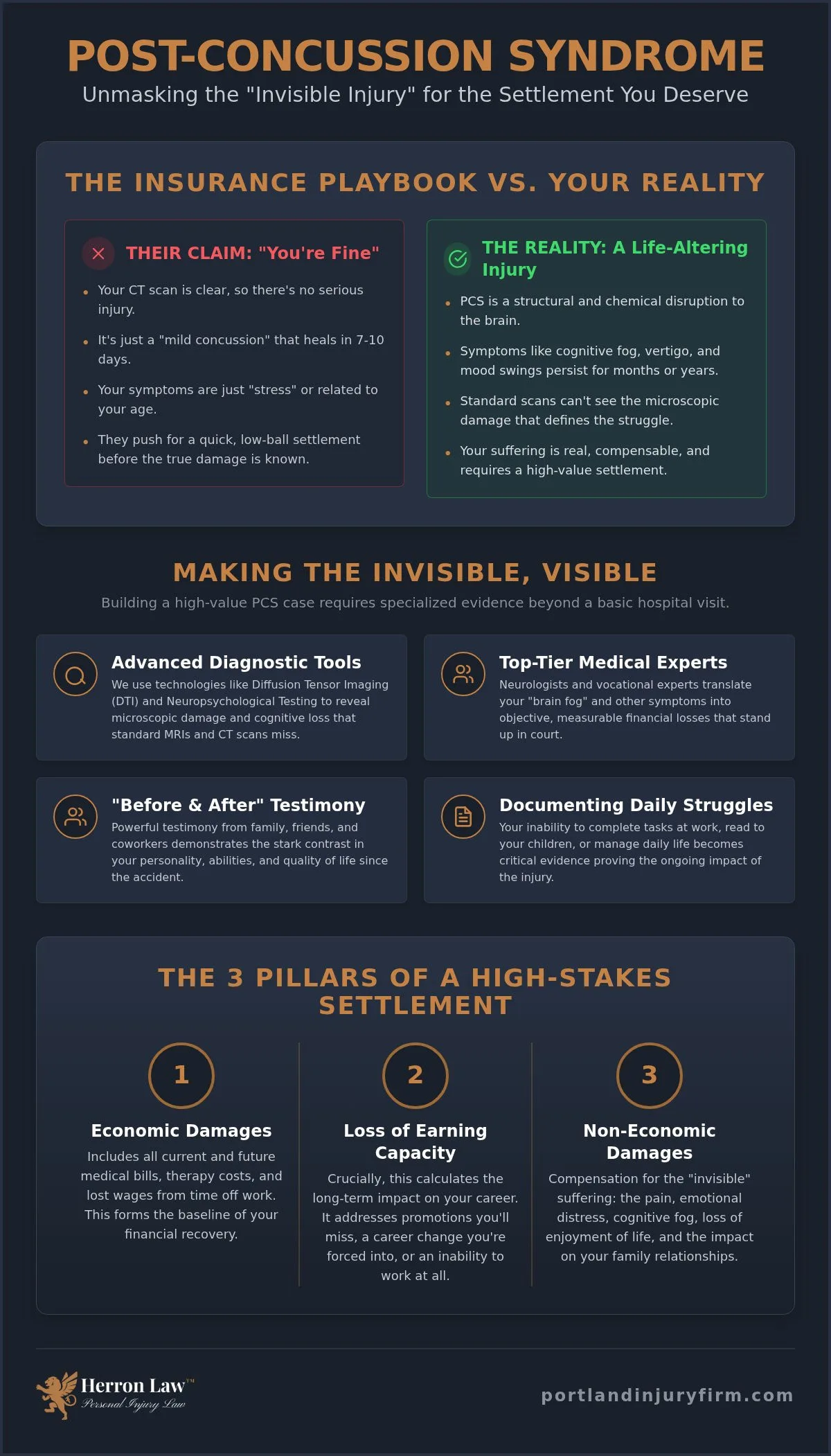
Your CT scan is clear, so the insurance company claims you’re fine. They’re wrong. They want you to believe that if a standard medical screen doesn’t show a bleed, your injury isn’t serious. This is a calculated tactic designed to devalue your suffering and protect their bottom line. We know the truth. Post-concussion syndrome is a life-altering catastrophic injury that can’t always be caught by a machine, but it’s felt every single day in the fog that won’t lift and the vertigo that keeps you from your career. You’re likely exhausted from being told your pain is invisible while you struggle to maintain your family life in Portland.
We agree that your suffering is real and compensable. It’s time to stop playing by the insurance company’s rules. You’ll learn exactly how to secure the high-stakes post concussion syndrome settlement you deserve by dismantling common defense excuses. We’ll preview the specific medical evidence required to prove ongoing harm in 2026, explain how we calculate the true long-term value of your claim, and show you how we act as a relentless shield and sword to take the fight directly to the giants who want to settle for pennies.
Key Takeaways
- Distinguish between a “minor concussion” and the medical reality of PCS to force insurance companies to recognize the true extent of your injury.
- Learn why a clear CT scan does not mean your brain is healthy and how specialized experts prove your “invisible” symptoms are compensable.
- Discover the three pillars used to calculate a high-stakes post concussion syndrome settlement, including often-overlooked impacts on your long-term earning capacity.
- Master the Oregon-specific battle plan to protect your rights after a crash and avoid the common traps set by aggressive insurance adjusters.
- Understand why a relentless, warrior-style legal strategy is the only way to secure the maximum financial restoration your brain injury requires.
What is Post-Concussion Syndrome and Why Does It Merit a Settlement?
Insurance adjusters love the term “mild concussion.” It sounds temporary. It sounds cheap. But for many victims of Portland car wrecks, truck collisions, or pedestrian strikes, the reality is far more clinical and damaging.
Post-Concussion Syndrome (PCS) is the persistent, agonizing echo of a traumatic brain injury (TBI) that refuses to fade. It’s not a minor bump on the head; it’s a structural and chemical disruption of your most vital organ. A high-value post concussion syndrome settlement accounts for the fact that your brain is the engine of your life, and when that engine is damaged, every aspect of your existence stalls.
In the 2026 legal environment, brain health is no longer treated as a secondary concern. We view it as a primary damage category. Whether you were hit by a distracted driver on I-5 or caught in a devastating commercial truck wreck, the law recognizes that your cognitive integrity has a massive financial value. If your symptoms persist, you aren’t just “healing slowly.” You’re dealing with a catastrophic shift in your health that demands aggressive
catastrophic injury legal representation to ensure the negligent party pays for the long-term fallout.
The Transition from Concussion to PCS
Most people expect to bounce back from a concussion within 7 to 10 days. That’s the standard recovery window the insurance company uses to justify their low-ball offers. PCS is the medical reality that breaks that timeline. If you’re weeks or months past your accident and still battling vertigo, a relentless cognitive fog, or uncharacteristic mood swings, your claim has entered a different league. These aren’t just annoyances; they’re signals of a long-term legal claim. Post-concussion syndrome is a neurological disruption that demands full financial restoration.
Why Insurance Companies Try to Devalue Your PCS Claim
The “Invisible Injury” defense is the oldest trick in the book. Because your brain doesn’t show a fracture like a broken leg, adjusters will point to a clear MRI or CT scan as “proof” that you’re fine. They’ll try to blame your inability to focus on your age, or claim your irritability is just “accident-related stress.” They want you to accept a quick check for a simple concussion before you realize your symptoms are permanent. Don’t let them trick you into signing away your right to a post concussion syndrome settlement before the full scope of the damage is known. We see through these tactics and build the medical evidence required to prove that a clear scan doesn’t equal a healthy brain.
Proving the “Invisible Injury”: Evidence Required for a PCS Lawsuit
A “normal” CT scan is the insurance company’s favorite weapon. They use it to suggest you’re exaggerating or that your symptoms are all in your head. We don’t let them get away with it. A standard scan only looks for structural damage like bleeds or fractures. It misses the microscopic shearing of axons and the chemical imbalances that define your struggle.
Proving the ‘Invisible Injury’ requires a tactical approach that goes far beyond basic hospital records. We build your case by making the invisible, visible.
Building a high-value post concussion syndrome settlement depends on specialized expertise. We don’t just rely on your primary care doctor. We bring in top-tier neurologists and vocational experts who understand how to translate your “brain fog” into a measurable financial loss. Documenting your daily cognitive struggles is essential. If you can’t read a bedtime story to your kids or lose your place in a work meeting; that’s evidence. We use “Before and After” witness testimony from family and coworkers to demonstrate the stark contrast between the person you were and the person you’ve become since the crash. This human testimony is often more persuasive to a jury than any medical chart.
Advanced Diagnostic Tools Beyond the MRI
We leverage technology that insurance adjusters hate. Diffusion Tensor Imaging (DTI) can see the microscopic white matter damage that standard MRIs ignore. Neuropsychological testing provides an objective baseline of your loss of focus, memory, and executive function. You need a Portland-based specialist who understands TBI litigation and isn’t afraid to stand up in court. This scientific data turns your subjective pain into an objective, compensable reality.
The Paper Trail: Medical Records and Consistency
Gaps in treatment are a gift to the defense. If you skip a doctor’s appointment, the insurance company will claim you’ve recovered. We demand consistency. We connect the specific mechanics of your crash, whether it was a high-speed highway wreck or a low-impact pedestrian strike, directly to the brain trauma you’re experiencing. Consistency in reporting symptoms is the foundation of your recovery. If you are struggling to get the answers you need from your current doctors, it may be time to
discuss your legal options with a team that knows how to fight for the maximum value of your brain injury.
Calculating Your Post-Concussion Syndrome Settlement Value
Valuing a brain injury isn’t about looking at a spreadsheet of current hospital bills. It’s about projecting the total cost of a life that has been fundamentally altered. To secure a maximum
post concussion syndrome settlement, we build your demand on three non-negotiable pillars: medical restoration, economic loss, and quality of life. In 2026, we must also factor in rising medical costs and inflation to ensure your recovery doesn’t run dry in five years. We don’t just guess at these numbers. We calculate them with mathematical precision to reflect your actual loss.
If you work in a “brain-heavy” profession, like tech in the Silicon Forest or healthcare in Portland, a 10% drop in cognitive speed isn’t just a minor issue. It’s a career-killer. We calculate the “promotion gap” where your injury prevents you from reaching the peak of your earning potential. We don’t just ask for what you lost yesterday; we demand what you would have earned tomorrow. For chronic neurological issues like
Post-Concussion Syndrome, we use a higher multiplier for pain and suffering because your injury never “clocks out.”
Economic Damages: More Than Just Hospital Bills
Your settlement must cover the full spectrum of future care. This includes specialized speech therapy, occupational therapy, and long-term medications to manage chronic vertigo or migraines. We analyze your lost wages and the specific impact on your unique career path. If you can no longer handle the high-stress demands of your previous role, the negligent party is responsible for that financial deficit.
Learn more about our practice areas and how we quantify these complex losses.
Non-Economic Damages: The Human Cost of PCS
Oregon law is clear: there is no cap on non-economic damages for standard motor vehicle accident cases. These “General Damages” cover the loss of enjoyment of life. This is the compensation for the bedtime stories you can’t read, the hobbies you’ve abandoned, and the constant anxiety that accompanies brain trauma. We fight to ensure the jury understands that emotional distress is a direct, physical consequence of your injury. Your mental health is an asset. We treat it as one. We refuse to let insurance companies dismiss your pain as “subjective” when it has objectively ruined your peace of mind.
The Battle Plan: How to Protect Your Claim in Oregon
The moments following a Portland car wreck are a high-stakes chess match. The insurance company has already started their clock. They’re hoping you’ll make a mistake. They’re waiting for you to say “I’m fine” at the scene or to an adjuster over the phone. In the world of traumatic brain injuries, “fine” is a dangerous lie that can cost you thousands. You need a shield between you and the corporate lawyers who are trained to dismantle your case before it even begins. Protecting your right to a
post concussion syndrome settlement starts with silence and ends with relentless legal action.
In Oregon, the statute of limitations for filing a personal injury claim is strictly two years from the date of the incident. In Washington, you generally have three years. While that might feel like a long time, building a bulletproof TBI case takes months of expert coordination and medical tracking. If you miss these deadlines, your right to recovery is gone forever. There are no second chances in the legal system. You must act with the same urgency the insurance company uses to protect their profits.
Navigating the Portland Legal Landscape
Multnomah and Washington Counties have specific tendencies that local victims must understand. Juries in these areas are often more educated about “invisible” injuries, but they also demand high-quality, objective evidence. Local insurance adjusters in the Pacific Northwest are notorious for using low-impact defense strategies, claiming that a minor fender-bender couldn’t possibly cause PCS. We know better. We understand the medical networks and the courtrooms from Gresham to Hillsboro.
Contact us to start your battle plan and ensure you aren’t outmaneuvered by local defense tactics.
Avoiding Settlement Traps
The “First Offer” is never their best offer. It’s a test of your desperation. Insurance companies are not your friends; they are profit-driven entities designed to pay you as little as possible. Another trap is your own social media. A single photo of you smiling at a backyard BBQ can be twisted by a defense lawyer to “prove” you aren’t suffering from cognitive fog or vertigo. They will use your digital life to kill your PCS claim. Stay off the grid. Let your medical records and your legal team do the talking. If you’re ready to take the fight to the insurance giants, it’s time to
discuss your strategy with a firm that treats your recovery as a mission, not just a file.
Why Herron Law is the Tactical Choice for Your PCS Case
Herron Law is not a high-volume settlement factory. We are a high-performance legal team built for combat. For 27 years, we have served as the shield and sword for Portland injury victims who have been cast aside by insurance giants. We have seen every corporate tactic used to devalue brain injuries. We have countered them all. When you are pursuing a
post concussion syndrome settlement, you don’t need a passive negotiator. You need a warrior who treats your financial restoration as a mission. We don’t just talk to adjusters; we prepare for trial from day one.
Our partnership with Morgan & Morgan provides us with the massive resources of a national powerhouse. This gives us the firepower to take on any insurance company, no matter how large. We combine this elite strength with a deeply personal focus on every individual we represent. You are never just a case number here. You are a priority. Our contingency fee promise is simple: you pay nothing unless we win. This removes the barrier to entry and allows you to focus entirely on your neurological healing while we focus on total victory.
A Record of Success in Catastrophic Brain Injuries
Experience matters when your future is on the line. We have handled over 2,000 cases and recovered millions for our clients in Oregon and Washington. We understand the unique challenges of proving an “invisible” injury like PCS. We know how to build a narrative that makes a jury feel your daily struggle with cognitive fog and vertigo. You need a
Personal Injury Lawyer: Your Tactical Shield Against Insurance Giants in 2026 who understands that a clear scan does not mean a clear life. We fight for the maximum value because we know the true cost of your suffering.
Start Your Fight Today with a Free Consultation
Your journey toward justice begins with a direct conversation. During your first meeting with Bart Herron, you will receive a tactical assessment of your claim. There are no upfront costs and no hourly billing. We operate with a results-oriented mindset that aligns our success directly with yours. We take the fight to the insurance company so you can reclaim your peace of mind. Don’t let another day pass while the defense builds their case against you. Take the first step toward the
post concussion syndrome settlement you deserve and
Demand Justice Now.
Take Command of Your Brain Injury Recovery
You’ve seen how insurance adjusters use “clear” medical scans as a weapon to devalue your pain. You now know that a successful
post concussion syndrome settlement requires specialized evidence and a refusal to settle for their first low offer. Your brain injury is real. Your suffering is compensable. You deserve a legal team that treats your recovery as a high-stakes mission rather than just another file.
Herron Law stands ready with 27+ years of Portland legal combat experience. We have recovered millions for our clients and operate as a proud affiliate of Morgan & Morgan. We provide the elite resources and relentless aggression needed to force insurance giants to the table. We don’t just ask for fairness; we demand it.
Don’t let the defense dictate the value of your life.
Get Your Free PCS Case Evaluation Now to begin your tactical battle plan. We’re ready to serve as your shield and sword in this fight. Your victory and your restoration are within reach.
Frequently Asked Questions
Is post-concussion syndrome considered a permanent disability?
It can be. While many people recover within months; a significant portion of victims face permanent cognitive impairment that qualifies as a disability under legal and medical standards. If your symptoms prevent you from maintaining gainful employment or performing daily tasks; we treat it as a catastrophic life change. We fight to prove that your invisible struggle is a permanent barrier to your previous quality of life and demands full financial restoration.
How much is the average settlement for post-concussion syndrome in 2026?
Settlement values vary wildly based on the severity of your cognitive loss and your specific career impact. While some smaller claims settle for approximately $30,000; severe cases involving long-term earning loss often exceed $250,000 or even $1 million. A high-stakes post concussion syndrome settlement depends on the quality of your medical documentation and the strength of your legal representation. We don’t settle for averages; we demand the maximum result.
What if my MRI and CT scans were normal after the accident?
A normal scan is not a clean bill of health for a brain injury victim. Standard imaging only detects structural damage like bleeds or fractures; it misses the microscopic cellular shearing that causes PCS symptoms. Insurance adjusters use these clear results to devalue your claim and call you a liar. We counter this by using advanced diagnostic tools and expert testimony to prove your brain is injured regardless of hospital machines.
Can I still sue if my concussion symptoms didn’t show up for weeks?
You absolutely can. Brain injuries are notorious for latent symptoms that emerge days or weeks after the initial impact as the brain’s chemistry shifts. The law recognizes this medical reality. As long as we can connect the crash mechanics to your eventual diagnosis; your claim remains valid. Never let an insurance company tell you that a delay in symptoms means your injury isn’t real. We build the bridge between the accident and your suffering.
How long does a post-concussion syndrome lawsuit take to settle?
Most complex brain injury cases take between 12 and 24 months to resolve properly. We refuse to rush into a settlement before you reach Maximum Medical Improvement. If we settle too early; we might leave money on the table that you need for future care. We move with urgency but prioritize the total value of your recovery over a fast, cheap check that won’t cover your long-term medical costs or lost wages.
What factors most affect the value of a brain injury settlement?
The three most critical factors are symptom duration; the impact on your earning capacity; and the clarity of the other party’s liability. If you work in a high-skill profession where cognitive fog prevents you from performing your duties; your settlement value increases significantly. We also look at your non-economic damages. This includes the loss of enjoyment of life and the emotional distress caused by chronic vertigo or personality changes following the wreck.
Do I need a lawyer for a “mild” concussion claim?
You do. Insurance companies use the word mild as a tactical label to justify low payouts and dismiss your pain. Without a relentless advocate; you are at the mercy of their profit-driven adjusters. We protect you from being bullied into a settlement that ignores the potential for long-term complications. A mild concussion can still result in a high-stakes post concussion syndrome settlement if handled by a firm that understands the true medical stakes.
What is the statute of limitations for PCS claims in Oregon?
In Oregon; you generally have two years from the date of the accident to file a lawsuit. Washington typically allows three years. These deadlines are absolute. If you miss them; you lose your right to demand justice forever. We recommend starting your battle plan immediately after your diagnosis to ensure all evidence is preserved and all local court requirements in Multnomah or Washington County are met before the clock runs out.