In Oregon, the law doesn’t care how much you’re hurting; it only cares who’s standing at the gate. While you’re buried in grief, insurance companies are already calculating how little they can pay to make you go away. They want you confused. They hope you’re too overwhelmed to navigate the red tape. They’re wrong. If you’re asking
who can file a wrongful death lawsuit in Oregon, you’ve already decided that “good enough” isn’t an option for your family.
We understand the fury and the fatigue you feel. It’s an exhausting battle against powerful forces that see your tragedy as a line item on a spreadsheet. You need a shield to block their tactics and a sword to cut through the noise. This article is your roadmap to taking control and demanding the restoration your family is owed.
You’ll learn why the “Personal Representative” is the only person allowed to lead this fight in court and how that role is assigned. We’ll identify which family members are legally entitled to a settlement and how to navigate the complex damages caps that adjusters use to limit your recovery. It’s time to stop wondering and start demanding the maximum justice your loved one deserves.
Key Takeaways
- Identify exactly who can file a wrongful death lawsuit in Oregon and why the “Personal Representative” is the only person with the power to demand justice.
- Discover which family members, including spouses, children, and parents, are legally entitled to receive compensation from a recovery.
- Learn about the strict three-year statute of limitations and why immediate action is required to prevent insurance companies from escaping liability.
- Understand the difference between having the right to file and proving the “wrongful act” necessary to secure a maximum financial settlement.
- See how a veteran legal advocate acts as your shield, managing complex probate filings and neutralizing aggressive insurance adjusters.
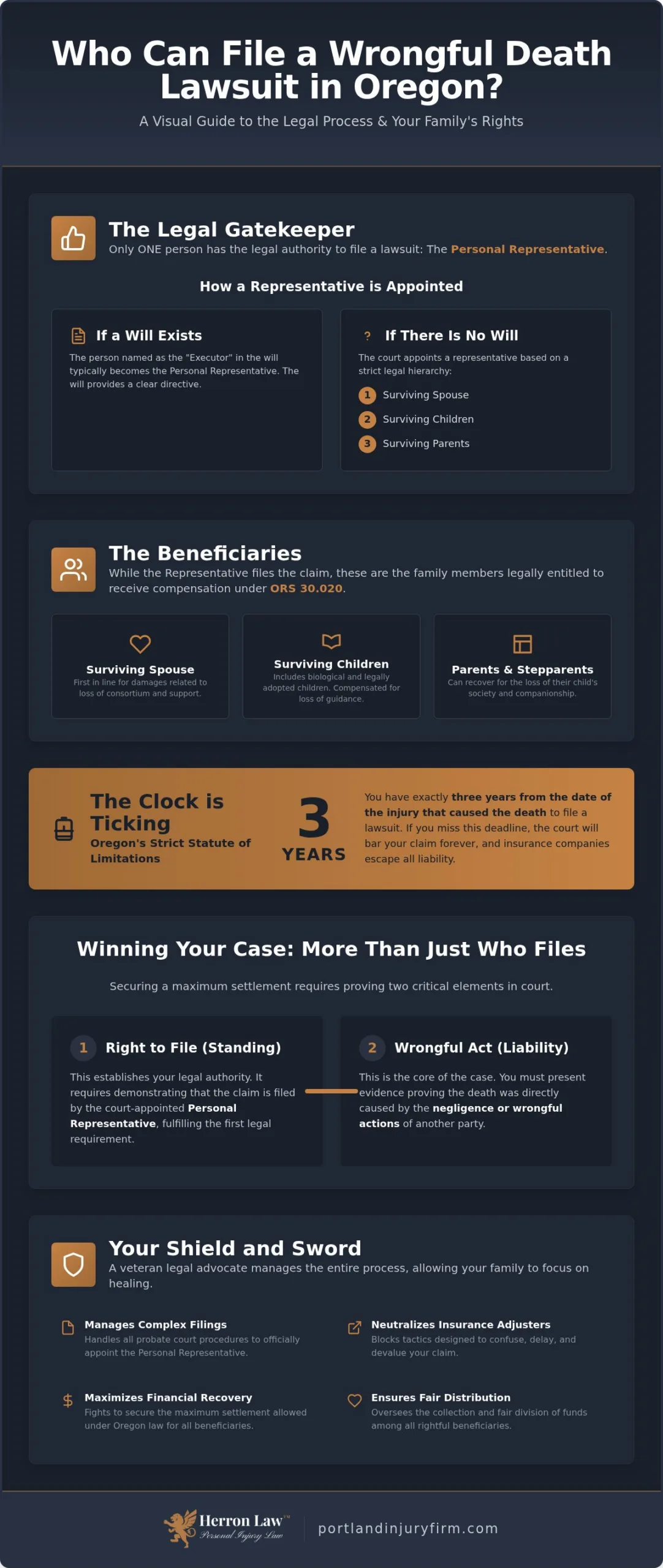
The Legal Gatekeeper: Understanding the Personal Representative Role
Oregon law is rigid. It doesn’t allow just any grieving family member to march into court. If you want to know
who can file a wrongful death lawsuit in Oregon, the answer is singular: the Personal Representative. This individual is the only person with the legal standing to initiate a
Wrongful death claim. Think of them as the gatekeeper. Without this specific designation, your case is dead on arrival. Oregon courts will dismiss any filing that lacks the proper representative status.
This role isn’t a prize. It’s a heavy legal burden. The representative doesn’t act for their own enrichment; they act as a shield for the estate and every qualifying beneficiary. They are the legal face of the fight, ensuring the responsible parties pay for the wreckage they caused. Filing without this authority is a waste of time that only helps the insurance companies escape justice.
How Oregon Appoints a Personal Representative
How do you get this authority? It depends on whether your loved one left a roadmap. If a valid will exists, the person named as executor usually steps into the role of Personal Representative. But what if there is no will? This is where many families get lost. Most legal websites gloss over this, but the process is critical.
In cases where no will exists, the Oregon probate court must appoint a representative. The law follows a strict hierarchy of priority. First, the surviving spouse has the right to lead. If there is no spouse, the children are next in line. Finally, the parents of the deceased may be appointed. We handle the complex probate filings to ensure the right person is empowered to strike back against the negligent parties.
The Duties of the Representative in a Wrongful Death Strike
Once appointed, the real work begins. The representative doesn’t just sit back. They must hire an elite
wrongful death attorney to spearhead the litigation. They are the primary point of contact. They approve settlements. They make the high-stakes decisions that determine the future of the family’s recovery.
The Personal Representative owes a strict fiduciary duty to the beneficiaries to act with total loyalty and maximize the value of the estate for those left behind. This means they cannot prioritize their own interests over other family members. When the insurance giants try to settle for pennies, the representative stands firm. They ensure the recovery is collected and distributed fairly among those who have suffered the most.
The Beneficiaries: Who Actually Recovers Damages in Oregon?
While the Personal Representative holds the legal sword, the beneficiaries are the ones the law aims to restore. Understanding
who can file a wrongful death lawsuit in Oregon is the first step; knowing who actually gets the money is the second. In many cases, the person leading the lawsuit is also a beneficiary, but that isn’t a requirement. The recovery is intended for the people who suffered the most from the loss, and Oregon law is very specific about who is allowed in that circle.
Insurance companies love to see family infighting. They hope that confusion over who gets what will stall the process or force a lower settlement. We don’t let that happen. We identify every rightful beneficiary early to ensure the “us versus them” battle remains focused on the negligent party, not your own family members. If you’re unsure where you stand, it’s time to
get a clear assessment of your rights.
Primary Beneficiaries Under ORS 30.020
The foundation of every claim is
Oregon Revised Statute 30.020. This law dictates the hierarchy of who can receive damages. It isn’t a suggestion; it’s a mandate. The primary groups include:
- Surviving Spouse: Usually the first in line for damages related to loss of consortium, financial support, and companionship.
- Surviving Children: This includes biological children and legally adopted children. They can demand compensation for the loss of parental guidance and financial stability.
- Parents and Stepparents: Oregon allows parents to recover for the loss of their child’s society and companionship, regardless of whether they were set to inherit from a will.
The Stepchild Exception in Oregon Law
Oregon is unique. Unlike many other states that ignore non-biological relationships, Oregon law explicitly allows stepchildren and stepparents to benefit from a wrongful death recovery. They don’t need to be “legal heirs” in the traditional sense of a will. If a stepchild can prove a meaningful relationship existed, they have a seat at the table.
This rule exists because the law recognizes that bonds aren’t always defined by blood. To be included, a stepchild must demonstrate that the relationship was substantial and that the death caused a genuine loss of companionship or support. We fight to make sure these relationships are respected and that every family member’s loss is accounted for in the final demand. If you’re wondering
who can file a wrongful death lawsuit in Oregon on behalf of a blended family, the rules are in your favor, but they require aggressive advocacy to enforce.
The 3-Year Deadline: Oregon’s Wrongful Death Statute of Limitations
Justice has an expiration date. It’s cold, hard, and final. In Oregon, you have exactly three years from the date of the injury that caused the death to file your claim. This isn’t a suggestion. It’s a wall. If you miss this window, your right to demand compensation is gone forever. Insurance adjusters know this. They’ll act friendly and offer “support” while they slowly bleed the clock dry. They’re waiting for evidence to disappear and memories to fade. Every day you wait is a win for the negligent party and a loss for your family’s future.
Waiting is the enemy of justice. While you’re processing your grief, the responsible parties are already building their defense. They want you to stay overwhelmed. They hope you’ll let the deadline pass so they can walk away without paying a dime. When you’re trying to figure out
who can file a wrongful death lawsuit in Oregon, you must also understand that the clock is ticking from the very first second. The
wrongful death laws in Oregon don’t make exceptions for those who simply didn’t know the rules.
The Discovery Rule and Potential Extensions
The clock usually starts at the moment of the fatal injury. However, the “discovery rule” can sometimes offer a slim lifeline. This rule states that the clock doesn’t start until the injury was discovered, or reasonably should’ve been discovered. This is common in cases of medical malpractice or hidden corporate negligence where the cause of death isn’t immediately obvious. While this sounds helpful, it’s a high legal bar to clear in court. You need a
personal injury lawyer who can act as your tactical shield and toll the statute before it’s too late.
Statutes of Repose: The Hidden Danger
There’s a hidden danger most people overlook: the statute of repose. This is a separate deadline that can kill a case even if the three-year window hasn’t closed. In product liability cases, for example, there’s an absolute limit on how long a manufacturer can be held liable after a product was first sold. A statute of repose differs from a statute of limitations by cutting off legal rights after a specific period of time regardless of when the injury actually occurred. If a defective car part was made ten years ago, a repose limit might bar your claim even if the accident happened yesterday. Understanding
who can file a wrongful death lawsuit in Oregon is useless if you don’t strike before these overlapping clocks run out.
Proving Liability: Why “Who Files” Is Only the First Step
Standing is just the price of admission. Knowing
who can file a wrongful death lawsuit in Oregon gives you the right to enter the arena, but it doesn’t hand you the victory. To secure justice, we must strip away the defense’s lies and prove that a “wrongful act or omission” led directly to your loss. This is where the real combat happens. We don’t just file papers. We reconstruct the accident, analyze black box data, and dismantle every excuse the responsible party tries to use to avoid accountability.
Our firm treats every case as if it’s heading for a jury in Multnomah County. We don’t prepare for a quick settlement; we prepare for war. When the opposition knows you’re ready to go the distance, their “best and final” offers suddenly get a lot more serious. We hunt for the evidence they try to hide, ensuring the truth is front and center.
Economic vs. Non-Economic Damages
Recovery isn’t just about paying back medical bills. It’s about full restoration. Economic damages cover the tangible losses: hospital invoices, funeral expenses, and the massive hole left by the decedent’s future lost wages. But the true cost of a life is often found in non-economic damages. This includes the pain, suffering, and devastating loss of companionship your family endures.
Oregon law currently attempts to cap these non-economic damages at $500,000 under ORS 31.710. However, recent 2026 court decisions like
Estate of Fisher v. Lee show that these caps are vulnerable to constitutional challenges in cases of catastrophic loss. We utilize elite expert economists to project the true financial value of your loved one’s life, ensuring the jury sees the full picture of the financial and emotional wreckage left behind.
Corporate Combat: Fighting Insurance Giants
Make no mistake: insurance companies are not your friends. They are multi-billion dollar entities driven by profit, not fairness. Their adjusters are trained to blame the decedent or minimize your family’s emotional trauma to save their shareholders a few pennies. They’ll use every deceptive tactic in the book to settle for a fraction of what your case is worth.
Herron Law acts as your tactical shield. We block their aggressive calls, handle their manipulative paperwork, and force them to deal with us directly. You focus on healing; we’ll focus on the fight. If you are ready to demand the maximum recovery for your family,
contact our team today for a relentless legal advocate.
Tactical Advocacy: How Herron Law Fights for Oregon Families
We don’t just “manage” files; we hunt for the maximum recovery your family deserves. Grief is a heavy enough burden. You shouldn’t have to carry the weight of a legal war alone. With over 27 years of experience and more than 2,000 cases handled, Bart Herron knows exactly how Oregon courts operate. He understands that the question of
who can file a wrongful death lawsuit in Oregon is just the starting line of a marathon. We act as both your shield and your sword, protecting you from aggressive adjusters while striking back at those responsible for your loss.
Our firm operates with total transparency. We work on a contingency basis, which means our fees are only collected upon a successful recovery. If we don’t win, you don’t pay. This structure ensures that we are as invested in your victory as you are. We handle the complex probate filings, manage the expert investigators, and neutralize the insurance company’s tactical games. While they try to protect their bottom line, we are focused entirely on your financial restoration and justice.
The Herron Law Process: From Filing to Victory
Our approach is methodical and high-impact. It begins with a free, no-nonsense consultation where we provide a direct assessment of your standing and the merits of your case. Once we accept a case, we deploy a team of experts to secure evidence before it’s scrubbed or lost. We don’t wait for the defense to move. We set the pace. If the responsible parties refuse to offer a fair settlement, we are fully prepared to take the fight into the courtroom. We treat every case with the total focus it deserves, ensuring you are never just a number on a spreadsheet.
Immediate Action for Portland Families
Time is your greatest enemy in a wrongful death claim. Evidence disappears, and the statute of limitations is always ticking. You need to begin the process of appointing a Personal Representative immediately to protect your family’s rights. This is the first and most critical step in determining
who can file a wrongful death lawsuit in Oregon for your specific situation. Do not sign any documents or accept any “goodwill” payments from an insurance company without our review. These are often traps designed to waive your right to a full recovery.
Take the first step toward justice today.
Contact Herron Law today for a free case evaluation.
Take Control of Your Family’s Recovery
You’ve lost enough. Don’t let a heartless insurance company or a complex legal system take anything else from you. Now that you know
who can file a wrongful death lawsuit in Oregon, the path forward is clear. You understand that a Personal Representative must be appointed to lead the charge and that the three-year statute of limitations is already counting down. Spouses, children, and even step-relatives have a legal right to the restoration they deserve. Waiting only gives the opposition more time to hide the truth.
At Herron Law, we act as your tactical shield against the forces trying to minimize your tragedy. With over 2,000 cases handled and the strength of our affiliate partnership with Morgan & Morgan, we have the elite resources needed to win. You won’t face any upfront costs or hourly billing; we only collect a fee when we secure a recovery for you. It’s time to stop wondering and start demanding the justice your loved one is owed.
Demand Justice for Your Family—Contact Bart Herron Now. You have the power to strike back, and we have the warrior spirit to lead the way. Your family’s healing begins with accountability.
Frequently Asked Questions
Can a sibling file a wrongful death lawsuit in Oregon?
Siblings are generally excluded from the list of beneficiaries in Oregon. Under ORS 30.020, the law prioritizes spouses, children, parents, and stepparents. While a sibling could technically be appointed as the Personal Representative by the court if no closer relatives exist, they usually don’t have a legal right to the financial recovery. We focus on ensuring the rightful beneficiaries receive every penny they are owed.
What happens if the Personal Representative is also the one at fault?
A Personal Representative cannot lead a lawsuit against themselves. If the person with priority for the role is the one who caused the fatal accident, the court will appoint an alternate. This ensures the estate’s interests are protected from a massive conflict of interest. We aggressively vet the appointment process to make sure the legal gatekeeper is someone who will fight for the family, not hide their own negligence.
How long does a wrongful death lawsuit typically take in Portland?
There is no fixed timeline, but most cases in Portland take between 12 and 24 months to resolve. Complex litigation involving corporate defendants or medical malpractice can stretch much longer. We work with urgency to push your case through the Multnomah County court system. Our goal is a swift victory, but we never sacrifice the total value of your claim just to finish early.
Can I file a wrongful death claim if there was no criminal charge?
Yes, you can. Criminal cases and civil lawsuits are entirely separate battles. A prosecutor’s decision not to file charges doesn’t block your right to demand justice. The burden of proof in a civil claim is lower than in a criminal trial. Even if the defendant is found “not guilty” in criminal court, we can still win a wrongful death settlement by proving their negligence led to the fatality.
What is the maximum amount I can recover for wrongful death in Oregon?
There is no cap on economic damages like lost wages and medical bills. However, Oregon law currently limits non-economic damages to $500,000 under ORS 31.710. We don’t accept this as the final word. Recent 2026 court rulings have found this cap unconstitutional in specific catastrophic cases. We fight to bypass these arbitrary limits and secure the maximum financial restoration your family deserves after a devastating loss.
Do I need a lawyer to appoint a Personal Representative?
While you aren’t legally required to have a lawyer, trying to navigate the probate court alone is a mistake. The process for
who can file a wrongful death lawsuit in Oregon involves complex filings that insurance companies will use to trip you up. We handle the entire appointment process so you don’t have to deal with the red tape. This allows you to focus on your family while we build your legal shield.
What if the deceased person lived in another state but died in Oregon?
Oregon law typically governs the case if the fatal injury occurred within the state. It doesn’t matter where the deceased lived or where the defendant is headquartered. If the negligence happened on Oregon soil, the rules for
who can file a wrongful death lawsuit in Oregon apply. We have deep roots in the Portland legal community and understand how to leverage local statutes to win against out-of-state corporations.
How are wrongful death settlements divided among family members?
Settlements are divided based on the specific losses suffered by each beneficiary. If the family cannot agree on a distribution, the court will hold a hearing to decide. This involves looking at the financial dependency and the emotional bond each person had with the deceased. We provide the tactical advocacy needed to ensure the division is fair and that the insurance company’s money goes exactly where the law intended.