Insurance adjusters aren’t your allies. They are professional delay-artists waiting for your legal rights to expire. While you focus on grieving an unthinkable loss, they focus on the calendar. In our state, the wrongful death statute of limitations Oregon families face is a hard line in the sand. If you cross it without filing, your chance for justice is gone forever. It’s a brutal reality that favors the negligent and punishes the grieving.
We know that taking legal action feels impossible when you’re still processing the funeral. The anxiety of being denied by a massive insurance company only adds to the weight. You deserve a shield against these tactics. This guide reveals the exact legal windows you need to navigate to protect your family. We’ll break down the standard three-year filing window and the hidden exceptions that could extend or shorten your time. You’ll discover a clear path to hold the responsible parties accountable without any upfront costs. Don’t let a corporate deadline silence your loved one’s story. Learn how to fight back before the clock runs out.
Key Takeaways
- Master the rigid three-year window under ORS 30.020 and why the wrongful death statute of limitations Oregon is the most critical deadline your family faces.
- Learn how the “Discovery Rule” acts as a legal safety net when negligence is hidden, ensuring the clock only starts when the truth is revealed.
- Identify the rare exceptions and tolling rules that can pause the countdown, providing a vital second chance for justice in complex cases.
- Discover why waiting is a tactical mistake that allows evidence to vanish while insurance companies build a file against you.
- Secure an elite advocate to handle the legal combat on a contingency basis, allowing you to demand maximum restoration without financial risk.
The 3-Year Rule: Decoding Oregon Revised Statute 30.020
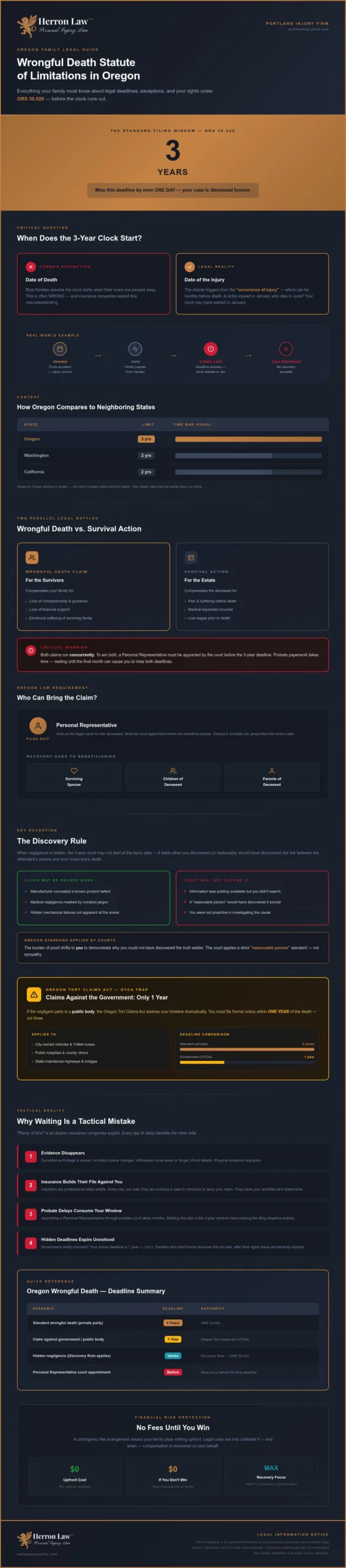
Oregon law is specific. It gives you a larger window than many neighbors, but that extra time is a double-edged sword. Under ORS 30.020 as of 2026, a wrongful death action must be commenced within three years after the occurrence of the injury causing the death. This is the wrongful death statute of limitations Oregon families must respect to keep their case alive. Don’t let the three-year mark fool you into complacency. While states like California or Washington often stick to a two-year limit, Oregon’s timeline is rigid. If you miss it by a single day, the court will throw your case out. No excuses. No second chances.
The “occurrence of injury” is the critical trigger. It isn’t always the date of death. If a negligent truck driver causes a catastrophic injury today, but the victim passes away six months later from those injuries, your countdown may have already started. We’ve seen insurance companies exploit this confusion. They wait for you to focus on your grief while the clock ticks toward expiration. You need a shield against these tactics.
Wrongful Death vs. Survival Actions
You are likely dealing with two distinct legal battles at once. A wrongful death claims filing focuses on the survivors; it compensates you for the loss of companionship, guidance, and financial support. A survival action is different. It belongs to the estate of the deceased. It seeks recovery for the pain and suffering your loved one endured before they passed. In Oregon, these timelines are intertwined. They usually run concurrently. To win both, you must have a personal representative appointed by the court before the clock expires. This appointment process takes time. If you wait until the final month of the three-year window, you risk missing the deadline while waiting for probate court paperwork.
Who Can Bring the Claim in Oregon?
Not just anyone can walk into a courtroom and demand justice. Oregon law requires a Personal Representative to lead the charge. This individual acts as the legal voice for the deceased. While the Personal Representative files the suit, the recovery is for the beneficiaries. This includes the surviving spouse, children, and parents. Each has a right to seek compensation under the statute. If you are unsure who should lead your family’s fight, consulting an expert wrongful death attorney is the first step to securing your rights. We identify the correct path and ensure the wrongful death statute of limitations Oregon doesn’t become a barrier to your recovery. We handle the complex filings so you can focus on your family.
The Discovery Rule: When the Clock Actually Starts Ticking
Negligence isn’t always obvious at the scene of an accident. Sometimes, the real cause of a fatal injury is buried under layers of corporate deception, complex medical jargon, or hidden mechanical failures. The wrongful death statute of limitations Oregon usually begins at the time of the injury, but the Discovery Rule provides a vital exception. This rule functions as a legal safety valve for families; it ensures that the three-year clock only starts when you actually discovered, or reasonably should have discovered, the causal link between the defendant’s actions and your loved one’s death.
Oregon courts don’t grant this extension to everyone. They apply a strict “reasonable person” standard to your actions. The court will ask if a person exercising ordinary care would have uncovered the truth sooner. If a manufacturer hides a known defect in a car part, the clock might be paused. However, if the information was publicly available and you simply didn’t look, the court won’t be as forgiving. You must be proactive. As outlined in Oregon Revised Statute 30.020, the burden of proof often shifts to you to show why you couldn’t have known the truth earlier. If you suspect that a timeline is closing in, you should reach out for a case review to protect your right to file.
The 1-Year Notice Trap: Claims Against the Government
If the negligent party is a public body, the Oregon Tort Claims Act (OTCA) slashes your timeline. You must provide a formal notice within one year of the death. This applies to:
- City-owned vehicles and TriMet buses
- Public hospitals and county clinics
- State-maintained highways and bridges
Missing this one-year notice window usually kills your case before it even starts. It’s a mandatory requirement that catches many families off guard and requires immediate action to preserve your rights.
Medical Malpractice Wrongful Death Nuances
Fatal healthcare errors involve a five-year “Statute of Repose.” This is a hard stop. Regardless of when you discover the malpractice, you cannot file a claim more than five years after the error occurred. Hospitals often delay releasing records to burn through your time. We seize these records immediately to lock in your discovery date and protect your interests under the wrongful death statute of limitations Oregon. We don’t let them hide behind administrative delays while your family’s clock runs out.
Exceptions and Tolling: Can the Oregon Deadline Be Extended?
The clock isn’t always a countdown to defeat. In rare, high-stakes scenarios, Oregon law allows for “tolling.” Think of this as a tactical pause button on the wrongful death statute of limitations Oregon families must fight against. It doesn’t happen often. Insurance companies will argue tooth and nail to keep that clock running. But if a defendant uses fraudulent concealment to hide their negligence, the law may step in. If they lied to your face or buried evidence to prevent you from knowing a tort occurred, the window might stay open longer.
Another specific trigger involves the defendant’s physical location. If the party responsible for the death flees the state or remains in hiding to avoid service, the timeline can be suspended. Never assume these exceptions apply to your case without a relentless legal review. We’ve seen families lose everything because they relied on a “hunch” that the deadline was paused; for those in need of comprehensive legal support, the Botelho Law Group provides the type of full-service advocacy necessary to protect one’s rights in complex situations. We verify the facts and demand the court recognize your right to proceed. We serve as your sword and shield when the opposition tries to hide behind the calendar.
Minors and Mental Incapacity
The law offers a shield for the most vulnerable. When a child loses a parent, they aren’t expected to file a lawsuit on their own. Oregon provides protections for minors and those suffering from mental incapacity. However, these protections have limits. Tolling for a minor cannot extend the window indefinitely. Usually, the action must still be brought within five years of the injury or one year after the minor turns 18, whichever comes first. If the personal representative themselves becomes incapacitated, the court may allow a brief extension to appoint a successor. Time is still the enemy. Even with these protections, evidence decays and witnesses disappear. You must act while the trail is still warm.
The Statute of Repose vs. Statute of Limitations
While the statute of limitations is about when you file, the Statute of Repose is a “hard stop.” It’s the ultimate deadline that insurance companies pray for. In Oregon, different cases have different ceilings. For example, in products liability cases, there is often a 10-year repose period from the date the product was first purchased. If a defective tire causes a fatal crash 11 years after it was sold, you might be barred from recovery regardless of the three-year limit. We handle various practice areas where these overlapping deadlines create a minefield for survivors. You need an expert who knows how to navigate both the limitations and the repose periods to ensure your family isn’t left empty-handed. We identify these traps before they snap shut on your case.
The Tactical Risk of Waiting: Why ‘Plenty of Time’ is an Illusion
Three years sounds like an eternity. In reality, it’s a countdown to the destruction of your case. While you are honoring your loved one’s memory, the opposition is already in the trenches. Evidence evaporates. Skid marks on a Portland street fade within weeks. Black box data in a commercial truck is overwritten in days. Witnesses move, their memories blur, or they simply stop answering the phone. The wrongful death statute of limitations Oregon provides a window, but it does not preserve the truth. If you wait, you are handing the negligent party a head start they don’t deserve.
Insurance companies don’t spend the first year “evaluating” your claim. They spend it building a file against you. They want to see you hesitate. They want to see you miss the window of opportunity to secure vital physical proof. To an insurance adjuster, a claim filed at the last minute isn’t just late; it’s a glaring signal of legal weakness and desperation. They assume you don’t have the stomach for a high-stakes fight. They assume you’ll settle for pennies because you’re out of time. We don’t let that happen.
Corporate Combat: How We Secure Evidence Early
We treat every case like it’s going to trial from day one. Our approach is aggressive and immediate. We don’t wait for the police report to tell us what happened. We deploy private investigators to lock in witness testimony while the details are still fresh and undeniable. We issue “spoliation letters” to corporations and trucking firms immediately. These letters are legal commands that forbid the destruction of records, emails, and digital logs. If they delete evidence after receiving our notice, we hold them accountable in court. Herron Law starts the fight when the trail is hot, not when the statute is about to expire.
The Danger of the ‘Final Offer’ Trap
Expect a lowball settlement offer about six months before the wrongful death statute of limitations Oregon expires. It’s a calculated move. They know you’re anxious about the deadline. They hope you’ll take “something” rather than risk getting “nothing” if the clock runs out. You need an elite personal injury lawyer to act as your tactical shield against these giants. We demand maximum value because we’ve already built the evidence to win. If you want to hold them accountable, you must contact us today to launch your counter-offensive before the evidence disappears forever.
Herron Law: Your Shield Against the Oregon Statute of Limitations
Bart Herron doesn’t just practice law; he wages war against the insurance giants that profit from your silence. With over 27 years of elite experience and more than 2,000 cases under his belt, he understands the wrongful death statute of limitations Oregon better than the adjusters trying to use it against you. We don’t just file paperwork. We build a wall between your family and the corporate entities looking to exploit your grief. Our firm operates on a strict contingency basis. We take the entire financial risk. You pay nothing unless we win. This allows you to focus on healing while we handle the high-stakes combat required to secure your future.
Large firms often treat you like a case number in a database. At Herron Law, you get direct access to your attorney. We are a focused, high-performance partner, not a distant corporate machine. We manage every critical deadline and technical filing with absolute precision. You’ll never have to wake up wondering if a missed date killed your chance at justice. We are your tactical shield, ensuring the responsible parties are held accountable before time runs out.
Our Results in Fatal Accident Litigation
Our track record isn’t built on soft settlements. It’s built on a “Warrior Persona” that demands maximum financial restoration. We’ve recovered millions for Oregon families because we refuse to back down when the opposition gets aggressive. We know that in wrongful death claims, the stakes couldn’t be higher. You need an advocate who sees the opposition for what they are: a barrier to the justice your loved one deserves. We have the resources to outlast their delay tactics and the skill to win in court. Demand Justice Now—Contact Herron Law for a Free Consultation.
Serving Portland and Beyond
We are deeply rooted in the Pacific Northwest. From our base in Portland to the courtrooms of Beaverton, Gresham, Salem, and Eugene, we provide relentless representation for the underdog. We know the local judges. We know the specific tactics Oregon insurance adjusters use to delay and deny. This local expertise is your advantage. We understand how these courts operate and how to push your case through the system efficiently. For families facing specialized national litigation such as mesothelioma, you can learn more about Weitz & Luxenberg and their work across all 50 states. Don’t let the clock run out on your loved one’s legacy. We are ready to start the fight today and secure the results your family needs to move forward.
The clock is the insurance company’s greatest weapon. They are counting on your grief to paralyze you until the wrongful death statute of limitations Oregon expires. You’ve learned that while the three-year window seems generous, hidden traps like the one-year government notice and the five-year medical repose period can kill your case overnight. Evidence is disappearing every second you wait. Skid marks fade. Witnesses move. Digital logs get overwritten. You need a shield that doesn’t just watch the calendar but actively fights to preserve the truth.
With over 27 years of aggressive advocacy and millions recovered for Oregon families, Bart Herron knows how to stop the clock and start the recovery. We take the entire financial risk with our promise: no fee unless we win your case. You focus on healing; we’ll focus on the fight. Demand Justice for Your Loved One—Schedule a Free Consultation with Herron Law. Your family’s right to justice is worth fighting for, and we are ready to stand as your sword and shield.
Frequently Asked Questions
What is the statute of limitations for wrongful death in Oregon?
The wrongful death statute of limitations Oregon generally gives families a three-year window to file a lawsuit. This clock starts ticking on the date the injury occurred that eventually caused the death. Whether you are in Portland or Eugene, this deadline is rigid. If you fail to file your claim within this three-year period, the court will almost certainly bar you from seeking justice or recovery forever.
Can the 3-year deadline be extended if I didn’t know the cause of death?
Oregon’s Discovery Rule can sometimes extend the deadline if the cause of death was hidden or not immediately apparent. The clock may pause until you discovered, or should have discovered, the negligence. However, judges apply a strict “reasonable person” standard. If they decide you should have investigated sooner, they won’t grant an extension. You need an aggressive advocate to prove why the truth was unavailable to you earlier.
What happens if I miss the 180-day notice for a government claim?
While standard injury claims against public bodies require a 180-day notice, Oregon law allows a one-year notice period specifically for wrongful death claims under the Oregon Tort Claims Act. If you miss this one-year deadline for accidents involving city vehicles in Salem or public hospitals in Portland, your case is over. We prioritize these notices to ensure the government is held accountable before their special legal protections kick in.
Does the statute of limitations change if the death involved a drunk driver?
The three-year statute for the driver remains the same, but suing the business that over-served them is different. Oregon’s dram shop laws require a formal notice to the bar or restaurant within 180 days of the incident. This is a much faster, secondary deadline that catches many families off guard. We demand evidence from these establishments immediately to preserve your right to sue every party responsible for the tragedy.
Who is allowed to file a wrongful death lawsuit in Portland?
Only a court-appointed Personal Representative can officially file a wrongful death lawsuit in Portland or Beaverton. While the surviving spouse, children, and parents are the beneficiaries who receive the compensation, they cannot file the suit individually. Our firm handles the complex probate process to have a representative appointed quickly. This ensures the wrongful death statute of limitations Oregon doesn’t expire while you are stuck in administrative paperwork.
Is there a limit on how much money I can recover in an Oregon wrongful death case?
Oregon currently caps non-economic damages, such as pain and suffering, at $500,000 in most wrongful death cases. However, there is no limit on economic damages. This includes medical bills, funeral expenses, and the total lost financial support the deceased would have provided. We fight to document every cent of economic loss to ensure your family receives the maximum restoration possible, regardless of arbitrary caps on your emotional suffering.
Can a minor child file a claim after the 3-year limit has passed?
Minor children have extra protections, but they aren’t infinite. The law may pause the deadline for a child, but Oregon generally imposes a five-year “hard stop” from the date of the injury. Waiting until a child turns 18 is a tactical disaster. Evidence fades and witnesses disappear long before then. We recommend starting the fight immediately to lock in the proof needed to win the child’s future security.
What is the difference between a statute of limitations and a statute of repose?
A statute of limitations is a countdown starting from the injury or its discovery. A statute of repose is an absolute cutoff based on when the defendant’s act occurred. For example, Oregon products liability cases have a 10-year repose period. If a defective car part causes a death 11 years after it was sold, you may be barred from recovery even if you are within the three-year limitation window.