The criminal justice system isn’t built to make you whole. It’s built to process cases, and too often, it leaves survivors standing alone in the wreckage of a traumatic event. You’re left with the bill for therapy, medical costs, and a haunting lack of closure. It feels like the power is entirely in someone else’s hands. That ends now. Filing a civil lawsuit for sexual assault isn’t just about legal filings. It’s a proactive strike to reclaim your agency and force the responsible parties to pay for what they’ve done.
You know that a “not guilty” verdict or a dropped charge doesn’t change the truth of what happened. We agree that the system is often broken, but the civil courts offer a different battlefield where you hold the upper hand. This article will show you how a civil claim provides a path to financial restoration and total accountability, independent of a prosecutor’s decisions. You’ll learn how to target both the individual attacker and the institutions that allowed the abuse to happen, securing the resources you need for your recovery and long-term peace of mind. It’s time to stop feeling like a victim and start acting like the powerful survivor you are.
Key Takeaways
- Understand how a civil lawsuit for sexual assault allows you to demand financial restoration even if the criminal justice system fails to secure a conviction.
- Learn why the lower “preponderance of evidence” standard in civil court makes it a more effective tool for holding your attacker accountable.
- Discover how to target not just the individual perpetrator, but also the negligent institutions and employers who allowed the abuse to happen.
- Identify the specific types of damages you can recover, ranging from immediate medical bills to compensation for lifelong emotional trauma and pain.
- Find out how to pursue a high-stakes legal fight with zero upfront costs, ensuring your financial situation never stops you from seeking justice.
What is a Civil Lawsuit for Sexual Assault?
A civil lawsuit for sexual assault is a private legal strike against an abuser or a responsible institution. It’s a tool designed for personal accountability and total financial restoration. Unlike the criminal system, which focuses on the state’s interest in punishing a defendant with jail time, the civil system focuses entirely on the plaintiff. It’s about you. You control the pace of the litigation. You decide when to settle and when to push for a high-stakes trial. This process transforms you from a witness in the state’s case into the primary driver of your own justice. High-profile victories, such as E. Jean Carroll v. Donald J. Trump, prove that the civil courts provide a sense of closure and financial victory even when the criminal system remains silent.
The Purpose of Seeking Civil Justice
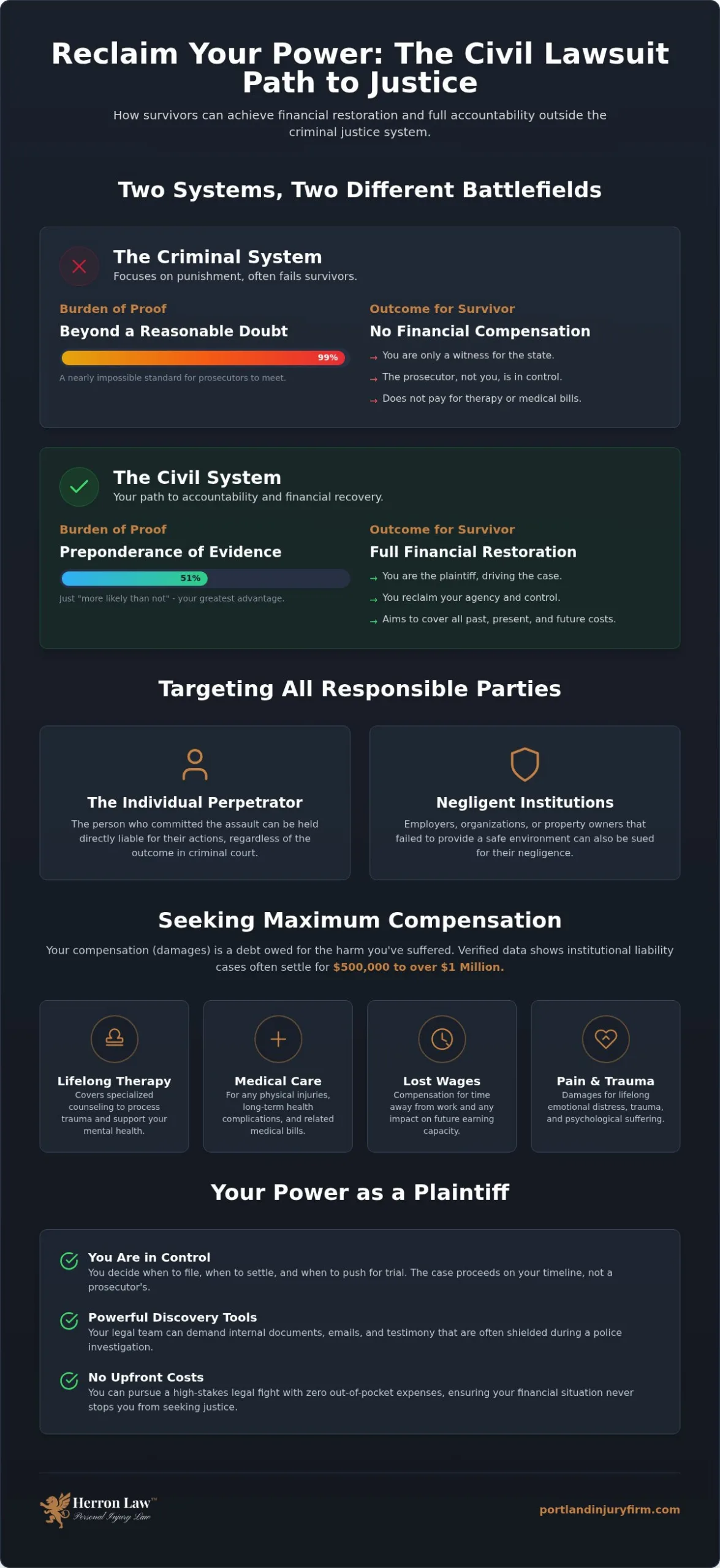
The criminal justice system is notoriously difficult to navigate. Prosecutors often drop charges or refuse to file them because they can’t meet the “beyond a reasonable doubt” standard. This creates a massive justice gap that leaves survivors feeling abandoned. A civil lawsuit closes that gap. The primary goal is seeking “damages,” which is a legal term for the financial compensation you are owed. This money isn’t a gift; it is a debt for the harm, trauma, and losses you’ve suffered. Verified data from August 2026 shows that cases involving institutional liability often result in settlements ranging from $500,000 to over $1 million. These funds are vital for securing your future, covering costs such as:
- Lifelong Therapy: Specialized psychological counseling to process the trauma.
- Medical Care: Treatment for physical injuries or long-term health complications.
- Lost Wages: Compensation for time away from work and reduced earning capacity.
By filing suit, you send a clear message to the perpetrator and the public. Predatory behavior has a high financial cost that the responsible parties must pay in full.
From Victim to Plaintiff: Reclaiming Your Agency
The psychological shift from victim to plaintiff is a transformation. In a civil case, you stand on equal footing with your attacker. You are no longer waiting for a government official to decide if your story is worth telling. You are taking proactive action. This shift in the power dynamic is a vital step in the healing process. When you’re backed by a relentless advocate with over 27 years of experience, you’re no longer an underdog. You’re a force to be reckoned with. Elite legal representation ensures you aren’t just a number in a file; you are a singular priority. You aren’t just surviving anymore. You’re fighting back and winning.
Civil vs. Criminal Justice: Understanding the Burden of Proof
The criminal justice system is built to punish. It puts people in cages. But it does absolutely nothing to pay your medical bills or fund your recovery. That’s why a civil lawsuit for money damages is often the only way to find true restoration. In a criminal trial, the prosecutor must prove their case “beyond a reasonable doubt.” That is a nearly impossible 99% threshold. In a civil lawsuit for sexual assault, the bar is much lower. We only have to meet the “preponderance of evidence” standard. This means we only need to prove it’s more likely than not that the assault occurred. Think of it as the 51% rule. If we prove there’s a 51% chance the defendant is liable, you win.
To gain a deeper understanding of how these cases are handled within the criminal justice system, particularly from a defense perspective, you can visit Marcelo Meriño Aravena.
This lower threshold is your greatest advantage. It explains why an acquittal in criminal court doesn’t prevent a massive victory in civil court. The state’s failure to lock someone up doesn’t mean they aren’t responsible for your trauma. You have rights that the criminal system ignores. For example, your legal team has the power of discovery. This allows us to demand internal documents, emails, and testimony that might be shielded or ignored during a police investigation. We hunt for the truth that the state often misses.
The Lower Threshold for Victory
The civil system prioritizes your needs over the state’s agenda. While a prosecutor might drop a case because it’s “too difficult” to prove to a jury’s absolute certainty, we don’t back down. A civil claim focuses on the intentional tort. This is a legal category for wrongful acts that cause harm. We don’t need to prove the attacker intended to break a specific criminal statute. We only need to prove they committed the act and you suffered because of it. It’s a direct, effective path to justice that doesn’t rely on a distracted district attorney.
Independent Timelines and Procedures
You don’t have to wait for the police. You can file a civil suit even while a criminal investigation is active. If the perpetrator is eventually convicted in criminal court, it often guarantees their liability in your civil case. It’s an open-and-shut victory. But even if the police never identify the attacker, we can often hold the institution responsible through third-party liability. If you’re wondering how these timelines affect your specific situation, it’s best to discuss your options with an expert who knows how to navigate both systems simultaneously. You deserve a warrior who understands that justice delayed is justice denied.
Identifying Liable Parties: Who Can You Sue?
Most survivors believe their only legal target is the person who physically attacked them. That is a tactical mistake. While holding the individual perpetrator accountable is a necessary part of your journey, these individuals often lack the assets to cover your lifelong recovery costs. A strategic civil lawsuit for sexual assault looks beyond the attacker. We identify every person and entity that paved the way for the crime. We look for the “deep pockets”—the corporations and institutions that had the power to protect you but chose to look the other way.
Liability in these cases usually falls into four categories:
- Direct Liability: Holding the actual perpetrator personally responsible for their actions.
- Vicarious Liability: Holding an employer responsible for the actions of an employee committed during their work.
- Negligent Security: Suing property owners, such as hotels or apartment complexes, for failing to provide a safe environment.
- Institutional Negligence: Holding schools, churches, or hospitals accountable for systemic failures that allowed abuse to occur.
Suing Institutions and Corporations
Institutions often prioritize their reputation over your safety. They ignore red flags. They hide previous complaints. When a school or hospital fails to conduct a proper background check or ignores reports of predatory behavior, they are guilty of “Negligent Hiring” or “Failure to Supervise.” The failure to utilize professional investigative resources like HubHound for thorough screening is often a key piece of evidence in proving such negligence. Targeting a corporation is often the only way to secure a settlement that reflects the true scale of your trauma. Verified data from mid-2026 indicates that cases involving institutional or workplace liability frequently see settlements ranging from $500,000 to over $1 million. We don’t just want a check; we want to force these entities to change their broken systems so this never happens to anyone else again.
The Concept of Third-Party Negligence
Who owned the building where you were hurt? Did they know the parking lot was dangerous? Third-party negligence focuses on the environment. If a property owner knew or should have known about a risk of assault and did nothing to fix it, they are liable. This includes broken locks in hotels, unlit stairwells in apartment complexes, or lack of security on a college campus. We hunt for these “deep pockets” to ensure that when we win your case, you actually collect the money you’re awarded. A judgment against an individual is just paper; a judgment against a negligent corporation is a path to financial restoration. You’ve been powerless long enough. It’s time to demand the justice you deserve.
Proving Your Case: The Evidence Required for Success
Evidence is the fuel for your legal strike. Many survivors hesitate to move forward because they think they lack “hard” proof like DNA or a police report. They wait for a smoking gun that may never come. In a civil lawsuit for sexual assault, we don’t wait. We build. We gather every fragment of truth to create an undeniable narrative of liability. You don’t need a criminal conviction to win; you need a fortress of facts that proves your account is more likely than not.
Your testimony is the most powerful weapon in the room. In civil court, jurors weigh credibility, and your voice is the cornerstone of the case. We supplement your account with a wall of documentation. This includes medical records that prove physical harm and psychological evaluations that document the crushing weight of PTSD and emotional distress. We also hunt for digital fingerprints. Text messages, emails, and social media posts often reveal the perpetrator’s intent or contain admissions they thought were private. We use forensic experts to translate your trauma into a language the jury understands.
Building a Compelling Case File
Speed is your ally when building a case file. An immediate medical evaluation creates a contemporaneous record of the event that is difficult for the defense to dismiss. We also identify “outcry witnesses.” These are the friends, family members, or coworkers you confided in immediately after the assault. Their testimony bolsters your credibility and makes your account harder to challenge. For complex cases, we deploy private investigators to uncover the perpetrator’s hidden history. If they have a track record of abuse, we’ll find it. If you’re ready to start this investigation, reach out to our experienced legal team today to discuss your next move.
Overcoming the “He Said, She Said” Challenge
Perpetrators hide behind the “he said, she said” defense. They think that without DNA or a video, they can lie their way out of accountability. They’re wrong. Physical evidence isn’t a requirement for victory in civil court. We win by establishing patterns of behavior. We use “Prior Bad Acts” to show the jury that the defendant has a history of predatory conduct. During cross-examination, we don’t just ask questions. We expose inconsistencies and force the defendant to face their own lies under the pressure of elite legal scrutiny. We turn their silence against them and make the truth impossible to ignore.
Seeking Maximum Compensation: What is Your Case Worth?
Justice has a price tag. It isn’t a random number, and it certainly isn’t set by the person who hurt you. Filing a civil lawsuit for sexual assault is about calculating the total debt owed to you for the destruction of your peace of mind. We don’t just look at your current bills. We look at the trajectory of your entire life. Our firm has over 27 years of experience ensuring that survivors don’t just get a settlement; they get a recovery that reflects the true scale of their loss. We operate on a contingency basis, which means you pay nothing upfront. We only collect a fee when we win your case. This removes the financial barrier between you and the justice you demand.
When we build your demand, we categorize your losses into three distinct areas:
- Economic Damages: These are the quantifiable hits to your bank account. It includes every therapy session, every medical bill, and every paycheck you missed because you were too traumatized to work.
- Non-Economic Damages: This covers the “invisible” injuries. We demand compensation for your pain, suffering, emotional distress, and the loss of your ability to enjoy life as you did before the assault.
- Punitive Damages: In cases of especially egregious behavior, we ask the court to hit the defendant with additional fines. These aren’t just for you; they are designed to punish the perpetrator and deter others from committing similar acts.
Calculating the Full Cost of Trauma
Trauma doesn’t have an expiration date. If you need specialized counseling for the next twenty years, the defendant should pay for it. We work with experts to quantify the long-term impact of PTSD on your career and earning potential. If your trauma makes it impossible to advance in your field or maintain a steady job, that is a massive financial loss that must be recovered. We also account for the “invisible costs,” such as the strain on your personal relationships and the daily struggle to function in a world that feels less safe. We don’t leave a single cent on the table.
Why a Relentless Legal Advocate is Mandatory
Insurance companies are not your friends. They are multi-billion dollar entities that specialize in devaluing human suffering. They will try to offer you “crumbs” to make you go away quietly. Understanding how to fight insurance company settlement tactics is essential to ensuring you never accept less than the full value of your claim. You need a shield and a sword. We are a high-performance partner that remains unfazed by corporate legal teams. Our firm is always ready to go to trial. We don’t settle for less than you deserve because we know how to win in front of a jury. You have been a victim once. Don’t let the legal system make you a victim a second time. Demand justice today with a free, confidential consultation.
Take Back Your Future Today
The criminal justice system often leaves survivors behind, but a civil lawsuit for sexual assault puts the power back where it belongs: with you. You’ve seen that a criminal conviction isn’t required to demand total accountability. By targeting both individual abusers and the negligent institutions that allowed the harm to occur, you can secure the resources necessary for lifelong healing. This is your opportunity to turn the tables on those who took your peace of mind. You aren’t just a victim anymore; you’re a plaintiff taking decisive action.
You need a warrior who has seen it all and won. Herron Law provides over 27 years of aggressive legal advocacy for survivors. We’ve recovered millions for survivors and injury victims by refusing to back down against powerful opponents. Because we work on a contingency basis, you pay nothing unless we recover money for you. We act as your shield and your sword throughout this entire process. It’s time to demand the restoration you deserve. Contact Herron Law for a Confidential, Free Consultation and start your journey toward justice. You have the strength to fight back, and we have the expertise to win.
Frequently Asked Questions
Can I file a civil lawsuit if the police didn’t arrest my attacker?
Yes. You don’t need an arrest or a conviction to win. The civil system is entirely separate from the criminal one. We use a lower burden of proof called “preponderance of evidence.” While a prosecutor needs nearly 100% certainty, we only need to show it’s more likely than not that the assault occurred. This gives you a massive advantage when the police fail to act.
What is the statute of limitations for a sexual assault civil lawsuit?
It depends on your state. California has no limit for childhood abuse occurring on or after January 1, 2024. Adult survivors in California have a revival window through December 31, 2027, for institutional cover-ups. New York’s GMVA window is open until July 29, 2027. Time is your enemy. You must act before these legal windows slam shut and bar your claim forever.
Will my identity be public if I file a civil lawsuit for sexual assault?
Filings are generally public, but we can demand privacy. We often file motions to use a pseudonym like “Jane Doe” to protect your identity from the public record. This is a battle we fight in court to ensure your healing remains a private matter. Your safety and comfort are our primary focus while we aggressively pursue the defendant for what they’ve done.
How much does it cost to hire a lawyer for a sexual assault case?
You pay nothing out of pocket. We work on a contingency fee basis. This means we take on all the financial risk of the civil lawsuit for sexual assault. We only collect a fee if we recover money for you. If we don’t win, you don’t owe us a dime for our legal services. We fight for your recovery without adding to your financial burden.
Can I sue a business or school for an assault that happened on their property?
Absolutely. Schools, churches, and businesses are often the most liable parties. If they failed to provide adequate security or ignored previous red flags, they are responsible. Settlement data from 2026 shows that cases involving institutional liability often range from $500,000 to over $1 million. We hold these powerful entities accountable for their systemic failures and demand maximum compensation for your trauma.
What happens if the person who assaulted me has no money?
We look for third-party liability. If the individual attacker is “judgment proof,” we pivot to the institutions that allowed the assault to happen. This includes employers, hotels, or apartment complexes with negligent security. We find the “deep pockets” to ensure that your legal victory results in actual financial restoration. We don’t just win on paper; we win where it counts.
How long does a civil sexual assault case usually take to resolve?
Most cases take between twelve to twenty-four months to resolve. Complex litigation involving large corporations or schools can take longer. While the reported average settlement is around $43,000, cases with significant trauma or institutional negligence often reach much higher values. We push the pace to get you results as quickly as possible without sacrificing the value of your claim.
Do I have to testify in court if I file a civil lawsuit?
You may have to give a deposition or testify. Your account is the most powerful evidence we have in a civil lawsuit for sexual assault. However, many cases settle before a trial ever begins. If you do have to speak, we’ll be standing by your side as your shield and advocate. We ensure you’re prepared to speak your truth with confidence and strength.